Zum Inhalt springen
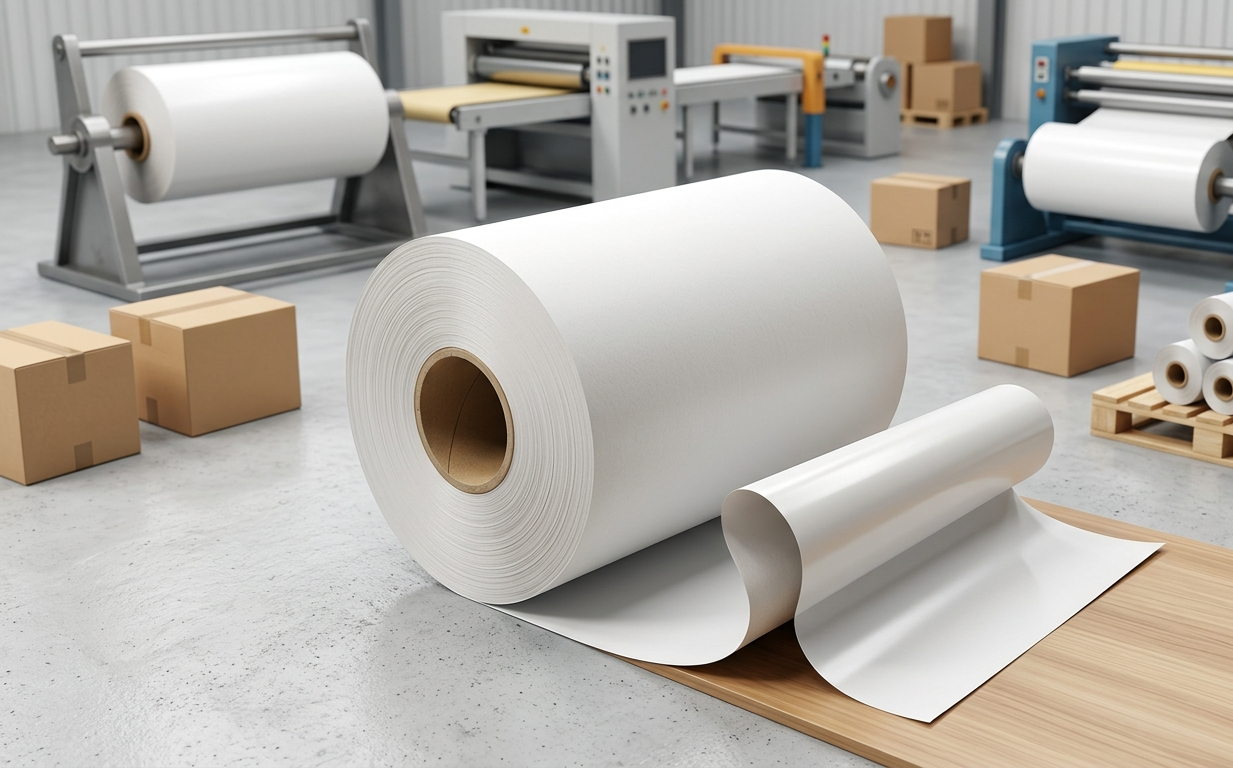
A release liner is the paper or film backing usually silicone-coated — that a sticky product rests on until you peel it off. It’s the sheet you throw away when you apply a label, a bandage, or a strip of tape. Its whole job: hold the adhesive safely, then let go the instant you need it to.
Nobody wakes up wanting to buy a release liner. They want a label. A tape. A graphic film. A wound dressing. The liner just tags along, the unglamorous carrier that makes the sticky thing usable. And then it turns out to be the part that ruins your week. Labels that won’t feed. Adhesive that tears mid-run. A converting line that jams at 2 a.m. and nobody can say why. Get the liner right, though, and you’ll never think about it again — which is exactly the point.
Spend enough time on converting floors and one thing sinks in: “release liner” isn’t a single product. It’s a whole family. Different substrates, different coatings, different release levels, each one matched to a specific pairing of adhesive and application. Let’s untangle it.
What a Release Liner Actually Does
Strip out the jargon and the liner has two jobs that fight each other.
Job one: grip the pressure-sensitive adhesive firmly enough that it won’t lift, shift, or pick up contamination while it sits in storage. Job two: let go cleanly, predictably, at the exact moment of use. Not so eagerly that the label sheds in transit. Not so stubbornly that the applicator chokes on it.
What balances those two? A release coating. Almost always a cured silicone, laid down on the liner surface. How much silicone, and which chemistry, sets the “release force.” A heavy tape that needs a firm grip and a delicate medical film that needs a whisper-light peel sit at opposite ends of that same dial.
The Main Types of Release Liner
Liners get sorted first by their base substrate, because the base drives cost, clarity, strength, and how the coating behaves on top of it. Want the deep version? Our guide to release liner types goes further. Here’s the working overview.
| Liner base | Made from | Stärken | Common uses |
| Kraft paper liner | Bleached or natural kraft | Economical, strong, tears predictably | Labels, tapes, graphics |
| Glassine liner | Densified, smooth paper | Very smooth, good release control | Stickers, medical, food |
| Clay-coated (SCK/PK) | Kraft with a smoothing coat | Excellent surface for coating | High-quality labels |
| Film liner (PET/PP) | Plastic film | Dimensionally stable, clear, tough | Die-cut precision, electronics |
| Poly-beschichtetes Kraftpapier | Kraft laminated with poly | Moisture barrier, stable | Industrial, tapes |
Paper-based liners run the market by sheer volume. They’re cheap, they print and convert easily, and the right ones recycle. Film costs more but it holds its shape under tension and heat, and that’s non-negotiable for precision die-cutting.
Silicone vs. Non-Silicone Release
Here’s the question buyers forget to ask: what’s actually doing the releasing? Silicone is the workhorse. Reliable, tunable, friendly with almost every adhesive out there. But it isn’t universal. Some jobs can’t tolerate even trace silicone migration think electronics, think certain medical settings — and that’s where non-silicone systems earn their spot. We put the two side by side in silicone vs. non-silicone release paper. Short version? Stick with silicone unless you’ve got a documented reason not to.
And then there’s the naming mess. Release paper, silicone paper, glassine people use them interchangeably, and they’re not strictly the same thing. If you’ve ever squinted at those three terms wondering which is which, our breakdown of release paper vs. silicone paper vs. glassine sorts it out.
How to Choose: The Variables That Actually Matter
Ask me to spec a liner and we walk the same short list every time. Skip any one and you’re rolling the dice on a mismatch.
- Release force. How easily should the adhesive peel? Set by the silicone level, and it’s the single most important spec. Match it to your adhesive and your dispensing method.
- Substrate strength. High-speed converting and roll-to-roll tension will snap a weak liner. Paper caliper or film gauge decides this.
- Surface smoothness. A rough liner prints its texture right into the adhesive. Smooth glassine or clay-coated bases give cleaner, more even release.
- Dimensional stability. Tight die-cutting and registration? Film holds its shape where paper stretches and shrinks with the humidity in the room.
- Caliper and weight. Thinner liners mean more length per roll and fewer changeovers. Thicker ones lie flatter and fight curl.
- Recyclability. Liner waste is a real line-item cost and a real sustainability question. Paper-based liners are usually easier to route responsibly.
Release Level: Reading the Spec Sheet
Release force gets described on a scale, roughly “easy” to “tight.” Understand that scale and you’ll dodge most of the complaints that ever land on a converter’s desk.
| Release level | Peel feel | Typical match |
| Easy / light | Peels with minimal effort | Delicate films, high-speed auto-apply |
| Mittel | Balanced, controlled peel | General-purpose labels |
| Tight / firm | Resists peel, holds strongly | Aggressive adhesives, heavy tapes |
The classic blunder goes one of two ways. Pair an aggressive adhesive with an easy-release liner and the label peels itself in the box. Pair a light adhesive with a tight liner and the automatic applicator can’t strip it off. Both stop a line cold. So when you’re unsure, hand your supplier the adhesive details and let them recommend the release level. Don’t guess at it.
Where Release Liners Show Up
Start noticing them and you can’t stop. Every price sticker on every product in your house. Packaging tape. Vinyl wraps on vans and storefront glass. Wound dressings and transdermal patches. Hygiene products. Thousands of tiny die-cut electronic parts you’ll never see. Each of those markets leans a particular way on base and release class, and a supplier who serves several of them like our Trennpapier operation in the USA — can usually pull a proven grade off the shelf instead of starting from a blank sheet.
A Quick Word on Sustainability
Liner waste has an image problem, and it’s earned historically the used backing went straight to landfill. That’s shifting. Paper-based liners with the right coatings can now feed dedicated recycling programs, and a lighter liner simply throws off less waste per roll to begin with. If sustainability sits on your scorecard, it’s worth folding the liner conversation into our wider look at eco-friendly paper packaging alternatives.
So here’s the takeaway. A release liner is a small, cheap component with an outsized power to make or wreck a converting run. Spec it on purpose substrate, release level, strength, smoothness and it vanishes into the background, which is precisely where you want it.
Häufig gestellte Fragen
Is a release liner the same as silicone paper?
Close, but not identical. “Silicone paper” just means any paper wearing a silicone release coat — and most release liners qualify. But “release liner” is the functional term for the backing that carries an adhesive product, and a handful of liners use non-silicone release chemistry instead. So every silicone liner is a release liner, while not every release liner is silicone. The gap only really bites when silicone migration would be a problem, like in some electronics, where you deliberately steer away from it.
Can release liner be recycled?
Depends on the base and on what your local streams accept. Paper-based liners are increasingly welcome in specialized programs built to deal with the silicone coating, while film liners follow whatever plastic route exists near you. Honestly, liner recycling is getting better but it’s still patchy region to region. The two most practical moves are picking a lighter liner in the first place and asking your supplier straight up whether they run a take-back or recycling partnership.
Why does my label lift off the liner during storage?
Nine times out of ten that’s an adhesive-versus-release-force mismatch. If the liner lets go too easily for an aggressive adhesive, the label starts creeping off on its own before it ever reaches an applicator. The fix is a tighter-release liner tuned to that specific adhesive. Send the adhesive spec to your supplier and let them recommend the release level, rather than swapping liners one at a time and hoping the next box behaves.
What is the difference between a paper liner and a film liner?
Paper liners — kraft, glassine, clay-coated — are cheap, easy to convert, and perfectly fine for most labels and tapes. Film liners in PET or PP cost more, but they hold their dimensions through tension, heat, and humidity swings, which is exactly what precision die-cutting and clear-on-clear jobs demand. If your process lives or dies on tight registration or optical clarity, film earns the premium. Otherwise paper usually wins on cost and on recyclability both.
How do I know which release force I need?
Work backward from the adhesive and the application method not from the liner. An aggressive adhesive, or a high-speed automatic applicator, needs a specific release window just to dispense without jamming, while a fragile film needs a light peel so it doesn’t tear on the way off. The dependable approach is to give your supplier the adhesive type and your dispensing setup and let them test-match it, because the right release force is a pairing, never a single fixed number.
Need liner recommendations for a specific adhesive or converting line? Browse our release paper product range or talk to our release paper specialists.
About the Author
Ashley Zack — Technical Content Lead, Kangchuang Papers
Ashley Zack has spent over a decade around industrial and specialty paper from mill-floor production to advising packaging engineers and procurement teams on grade selection. At Kangchuang Papers, they translate hands-on manufacturing experience into practical, jargon-free guidance for buyers sourcing kraft, release, newsprint, and anti-corrosion papers. When a spec sheet and a real-world packing line disagree, they’ve usually seen why firsthand.
Have a sourcing question or a grade you can’t pin down? Get in touch with the Kangchuang Papers team.