Ir al contenido
A packaging buyer for a frozen-food brand spec’d standard 150 GSM kraft for their inner wrapper, switched to a ‘similar’ moisture-resistant grade from a different supplier in Q2, and watched the package failure rate at the warehouse climb from 0.4% to 3.2% over three months. The buyer assumed moisture-resistant meant wet strength. They are not the same thing.
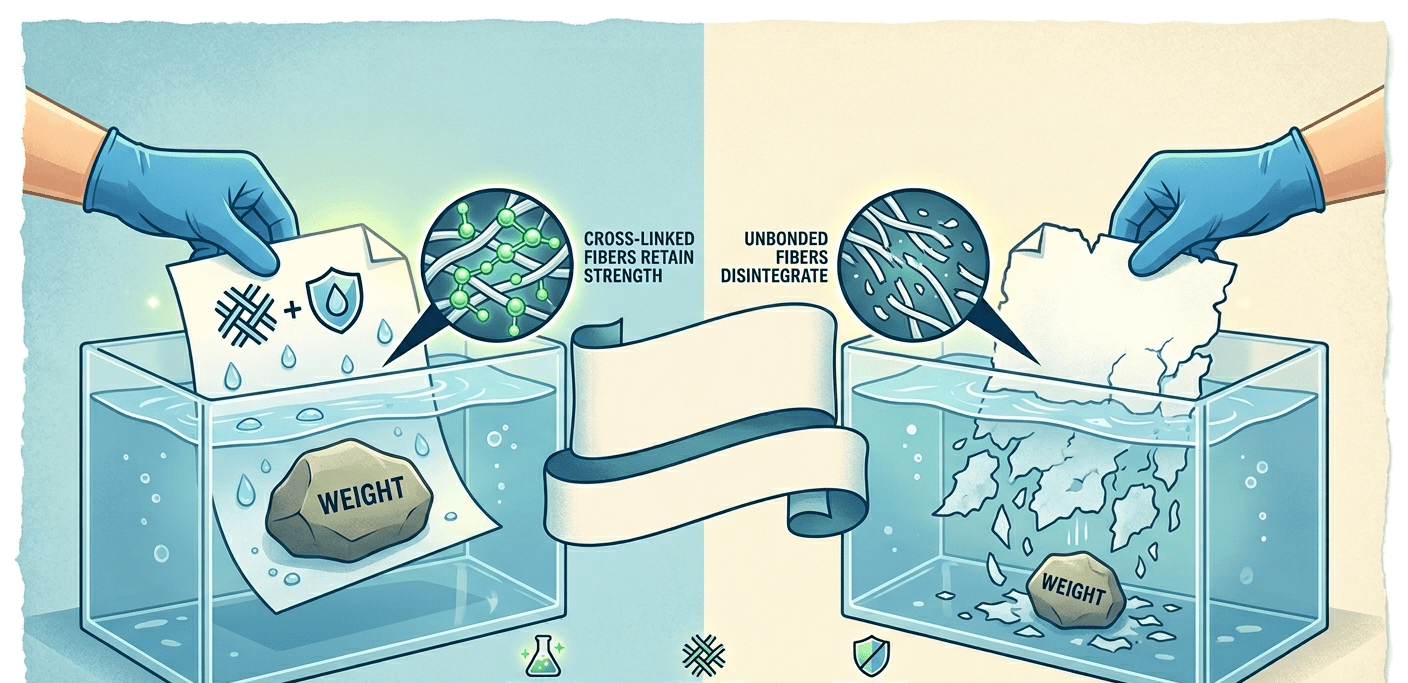
A paper coated with a moisture barrier resists water absorption on the surface but retains essentially zero tensile strength once water penetrates the substrate. A wet strength paper retains 25–50% of its dry tensile strength after full water immersion. The difference is in the chemistry, not the surface treatment — and the substitution that looks like a sourcing optimization on the spec sheet can produce a quality failure in the warehouse that costs 8–12× the savings.
Wet strength paper is a category of papers chemically treated during manufacture to retain meaningful tensile and burst strength after exposure to water, moisture, oils, or refrigerated condensate. It is required for food contact wraps, medical sterile-barrier packaging, outdoor and refrigerated labels, currency, filter media, and any application where the paper sees liquid contact during use. This guide walks packaging buyers through what wet strength actually means at the molecular level, the cost premium it carries in 2026, the application-to-spec match, and the four specification mistakes that produce surprise failures.
What ‘Wet Strength’ Actually Means — and How It’s Different from Moisture Resistance
Untreated paper is a hydrogen-bonded network of cellulose fibers. When water penetrates the structure, hydrogen bonds dissolve and the paper loses 95–98% of its dry strength within seconds. Wet strength chemistry — typically polyamide-epichlorohydrin (PAE) resin added during the papermaking process — forms covalent bonds between fibers that survive water exposure. The paper retains 25–50% of its dry strength when wet, depending on PAE loading and paper grade.
What wet strength is:
- Permanent — survives repeated wetting and drying without degradation
- Strength-preserving — paper retains tensile and tear after water immersion
- Internal — chemistry is distributed through the fiber network, not coated on the surface
- Cost-additive — typically adds $180–$420 per metric ton over equivalent untreated grade in 2026
What wet strength is not:
- Waterproof — wet strength paper still absorbs water; it just keeps its strength while doing so
- Moisture barrier — does not prevent water vapor transmission
- Surface treatment — distinct from PE-coated, wax-coated, or fluorochemical-treated papers
- A grease barrier — fluorochemical or silicone-coated grades handle grease
Confusing wet strength with moisture resistance is the source of most application failures in this category. The two properties serve different functions and are achieved with different chemistry. Our industrial paper specifications page documents which grades carry wet strength, which carry moisture barrier, and which carry both — none of which should be inferred from the GSM or surface appearance alone.
Where Wet Strength Is Required — and Where It Is Specified But Not Needed
Wet strength is a real engineering requirement in specific applications. It is also one of the most over-specified treatments in packaging procurement, with buyers adding it to RFQs as insurance against unknown future conditions and paying the cost premium without functional benefit.
Applications where wet strength is genuinely required:
- Food contact wrappers exposed to condensate, juice, or grease — sandwich wraps, deli paper, butcher paper
- Medical sterile-barrier packaging — autoclave indicators, surgical pouches, sterilization wraps
- Frozen and refrigerated product labels — condensation during thaw cycles destroys untreated label stock
- Outdoor or marine packaging exposed to rain, humidity, or sea spray
- Filter media — coffee filters, automotive air filters, water treatment cartridges
- Currency, deeds, and durable documents requiring multi-decade service life
- Wet-laid nonwovens for industrial applications
Applications where wet strength is over-specified:
- Dry retail bags and gift wrapping — no liquid exposure, no functional benefit
- Standard e-commerce shipping mailers — packaging design protects from short-term moisture; carrier handling does not produce sustained wet contact
- Indoor file storage — moisture-resistant boxboard would serve at lower cost
- Promotional and marketing materials — wet strength adds $0.04–$0.09 per square meter with no functional benefit
Specifying wet strength only where the application functionally requires it can cut paper spend 12–25% on packaging programs with mixed-application BOMs.
Wet Strength Paper Cost in 2026: Per-Ton, Per-Roll, and What Drives Pricing
Wet strength paper is sold by the ton like other industrial papers, with the PAE treatment adding to base-grade pricing. The premium depends on PAE loading (typically 0.5–2.5% by weight of fiber) and the underlying paper grade.
| Curso | Base Untreated Per-Ton 2026 | Wet Strength Premium | Total Per-Ton 2026 |
|---|---|---|---|
| Recycled kraft, 60–120 GSM | $720–$1,150 | +$180–$280/ton | $900–$1,430 |
| Virgin softwood kraft, 60–120 GSM | $920–$1,420 | +$240–$340/ton | $1,160–$1,760 |
| Virgin bleached kraft, 60–120 GSM | $1,080–$1,620 | +$280–$420/ton | $1,360–$2,040 |
| Food contact wet strength (FDA compliant) | — | +$60–$140/ton over standard wet strength | $1,280–$1,820 |
| Sterile-barrier medical grade | — | +$420–$680/ton over standard wet strength | $1,680–$2,420 |
| Premium 50% retention vs 25% retention | — | +$80–$160/ton | Same base + premium |
What moves wet strength pricing inside the bands:
- PAE loading — wet strength retention scales with PAE percentage; 25% wet/dry strength is standard, 40–50% is premium grade
- FDA compliance for food contact — adds documentation and lot-testing overhead; typically $60–$140 per ton
- Bleached vs unbleached substrate — bleached premium kraft adds 15–25% over brown
- GSM — wet strength chemistry cost scales with paper weight
- Order volume — 20-ton orders typically run 8–15% lower per-ton than 1–5 ton orders
- Roll width and core diameter — non-standard sizes carry $40–$120/ton premium
Wet strength is additive with other treatments. A paper specified as wet-strength, grease-resistant, and FDA-compliant for direct food contact (typical deli or sandwich wrap) lands at $1,280–$1,820 per metric ton in 2026 — a 60–80% premium over equivalent untreated kraft, but the application failure rate at the warehouse drops from 1–4% to under 0.2%.
Wet Strength Specification on the RFQ: What to Ask For
Specifying wet strength on a packaging RFQ requires more than a checkbox. The right specification includes the retention percentage, the test method, and any regulatory compliance requirements.
Specifications to include on a wet strength paper RFQ:
- Wet tensile retention percentage — typically 25–50% of dry tensile MD
- Test method — TAPPI T 456 (wet tensile breaking strength) is the standard
- Dry tensile MD baseline — needed to calculate the absolute wet tensile target
- PAE level disclosure — relevant for some regulatory and recycling considerations
- FDA compliance for food contact — 21 CFR 176.170 or 176.180 as applicable
- Cobb value (water absorption) — paired specification for moisture handling characterization
- Lot certification — wet tensile test results per shipment
Common procurement specifications by application:
- Food contact wrap — 30% wet retention minimum, FDA 21 CFR 176.170, Cobb ≤30 g/m²
- Medical sterile-barrier — 40% wet retention, ISO 11607 compliance, full lot traceability
- Frozen product label stock — 35% wet retention, freeze-thaw cycle testing on first lot
- Filter media — application-specific retention targets, often higher than 50%
Nuestro paper packaging programs document all of these specifications on every wet strength grade — pulling test data per shipment rather than relying on supplier attestation.
Four Specification Mistakes That Surprise Packaging Buyers
Wet strength mistakes show up at the warehouse or in the field, not at the RFQ. The four most-common buyer errors on first wet strength specifications:
- Confusing wet strength with moisture barrier — wet strength keeps the paper’s tensile after water exposure but does not prevent water absorption. For applications needing barrier, specify a coated grade (PE film lamination, wax, or fluorochemical) in addition to or instead of wet strength chemistry.
- Specifying wet strength without retention percentage — ‘25% retention’ and ‘50% retention’ are very different specifications produced by different PAE loadings. Always specify the retention target on the RFQ.
- Adding wet strength to dry retail packaging — paper bags, gift wrap, and indoor packaging gain no functional benefit and pay 18–30% cost premium. Audit BOMs to remove wet strength from applications that don’t need it.
- Specifying wet strength without checking FDA compliance for food contact — some PAE chemistries are not approved for direct food contact. Specify FDA 21 CFR 176.170 or 176.180 explicitly when the paper touches food.
Nuestro supply chain managers walk every first-time wet strength buyer through these four before quoting — preventing both the over-specification that wastes 18–30% on the wrong applications and the under-specification that produces field failures on the right ones.
The Kangchuang Wet Strength Paper Decision Framework
Use this framework to determine whether wet strength is the right treatment for an application and at what retention level.
| Solicitud | Wet Strength Needed? | Recommended Spec |
|---|---|---|
| Food contact wrap (deli, butcher) | Sí | 30% retention, FDA 21 CFR 176.170, Cobb ≤30 g/m² |
| Medical sterile-barrier pouch | Sí | 40% retention, ISO 11607, lot certified |
| Frozen / refrigerated label stock | Sí | 35% retention, freeze-thaw cycle tested |
| Outdoor / marine packaging | Sí | 30% retention + moisture barrier coating |
| Filter media | Sí | Application-specific, often 50%+ retention |
| Standard e-commerce shipping mailer | No | Standard kraft adequate; carrier moisture exposure is short |
| Indoor retail bag, gift wrap | No | Standard kraft; wet strength wastes 18–30% |
Preguntas frecuentes
What is wet strength paper and how does it work?
Wet strength paper is paper chemically treated during manufacture to retain meaningful tensile strength after exposure to water. The treatment typically uses polyamide-epichlorohydrin (PAE) resin added during papermaking — usually at 0.5–2.5% loading by fiber weight — which forms covalent bonds between cellulose fibers that survive water exposure. A typical wet strength paper retains 25–50% of its dry tensile strength after full water immersion, whereas untreated paper loses 95–98% of its strength within seconds of getting wet. The treatment is permanent (it survives repeated wetting and drying), internal (distributed through the fiber network rather than coated on the surface), and FDA-approved for direct food contact in compliant grades.
How much does wet strength paper cost per ton in 2026?
Wet strength chemistry adds $180–$420 per metric ton over the equivalent untreated grade in 2026, depending on PAE loading and underlying paper grade. A typical wet strength virgin softwood kraft at 80 GSM runs $1,160–$1,760 per metric ton FOB origin, versus $920–$1,420 for the same grade untreated. Food contact wet strength papers (FDA 21 CFR 176.170 compliant) carry an additional $60–$140 per ton premium for testing and documentation. Sterile-barrier medical-grade wet strength papers (ISO 11607 compliant) typically run $1,680–$2,420 per metric ton due to lot-level testing and regulatory compliance. The premium scales with PAE loading — 50% retention grades cost 8–15% more per ton than standard 25% retention grades.
When do I need wet strength paper and when is it over-specified?
Wet strength is genuinely required for: food contact wrappers exposed to condensate, juice, or grease (deli paper, butcher paper, sandwich wraps); medical sterile-barrier packaging (surgical pouches, sterilization wraps); frozen and refrigerated product labels where condensation occurs during thaw cycles; outdoor or marine packaging exposed to rain or humidity; and filter media. It is over-specified on dry retail bags, indoor gift wrapping, standard e-commerce shipping mailers (carrier moisture exposure is brief and uneven), promotional materials, and any indoor application without sustained liquid contact. Removing wet strength from applications that don’t need it typically cuts paper spend 12–25% on mixed-application packaging programs.
What is the difference between wet strength paper and waterproof paper?
Wet strength paper retains tensile and tear strength after water exposure but still absorbs water — the paper gets wet, just doesn’t fall apart. Waterproof papers are coated with polyethylene film, wax, fluorochemicals, or silicone treatments that physically prevent water from penetrating the substrate. The two properties serve different functions: wet strength matters when the paper needs to maintain structural integrity while wet (the paper is the structural element); waterproof matters when the paper needs to keep its contents dry (the paper is the barrier). Many applications need both — a food wrap may use PAE wet strength chemistry plus a grease-resistant fluorochemical coating, providing structural integrity when wet plus a barrier against grease and oil migration.
Is wet strength paper recyclable?
Yes, in most municipal recycling streams. PAE wet strength chemistry breaks down during the repulping process when subjected to the higher temperatures and longer residence times used at modern recycled paper mills. However, wet strength papers have somewhat reduced recovery rates compared to untreated kraft because the resin needs additional repulping energy, and very high PAE loadings (above 2%) can produce repulping difficulties. For mixed packaging streams (e-commerce mailers, retail packaging, food service papers), wet strength contribution is typically small enough that it does not affect overall mill performance. Some specialty wet strength papers using non-PAE chemistries (older formaldehyde-based or polyacrylamide systems) have more recycling friction but are increasingly replaced by PAE in new specifications.
Bottom Line
Three takeaways:
- Wet strength is internal chemistry that preserves tensile after water exposure — it is not a moisture barrier and not the same as PE-coated or wax-treated paper. Match the treatment to the actual application requirement.
- Specify retention percentage (25%, 40%, 50%), test method (TAPPI T 456), and regulatory compliance (FDA 21 CFR 176.170 for food contact) on every wet strength RFQ — leaving it ambiguous produces inconsistent supply across lots.
- Remove wet strength from BOM lines that don’t need it — dry retail bags, indoor packaging, and standard e-commerce mailers gain no functional benefit and pay 18–30% premium.