Ir al contenido
The four main release liner types are glassine, super-calendered kraft (SCK), PET film, and poly-coated kraft. Glassine is dense, smooth, and lays flat, which suits labels and graphic arts. SCK is polished kraft that fits most applicators and is a United States standard for product labels (Blue Label Packaging, 2026). PET film runs as thin as 23 microns, so a roll holds 20% to 30% more labels and breaks less on high-speed lines (Clear Print, 2022). Poly-coated kraft adds a polyolefin moisture barrier for humid jobs. Paper liners lead the global market because they cost less and print sharper than film.
What are the main types of release liner?
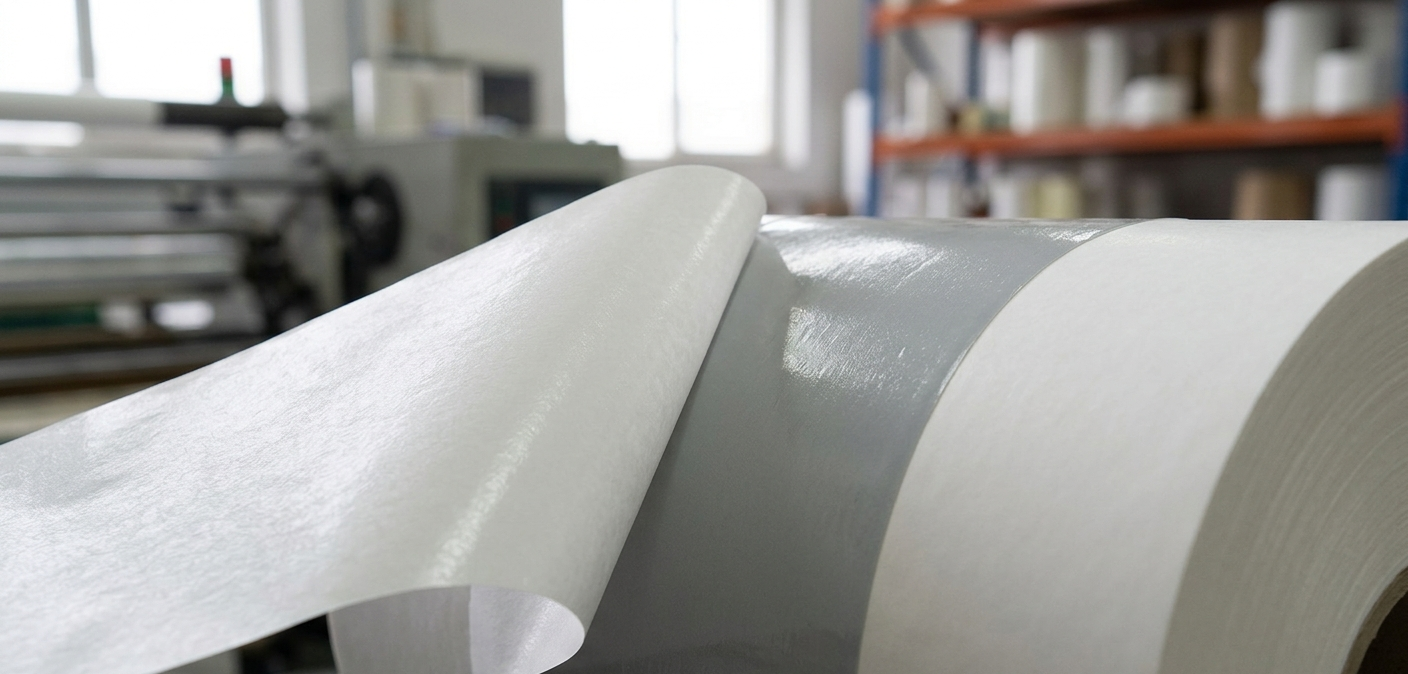
Release liners split into two families by base material: paper and film. Paper liners cover glassine, super-calendered kraft, and poly-coated kraft. Film liners are dominated by PET (polyester). Each base is coated with a release agent, usually silicone, so the adhesive peels away cleanly (Loparex, 2023).
Paper holds the largest share of the global release liner market, valued at $19.59 billion in 2025 (Grand View Research, 2025). The reason is practical: paper costs less, accepts ink for sharp printing, and lays flat during converting (Verified Market Research, 2024). Film earns its premium on high-speed, wet, or thickness-critical jobs. The right type depends on the adhesive, the application line, and the environment the finished label will face.
Glassine release liner
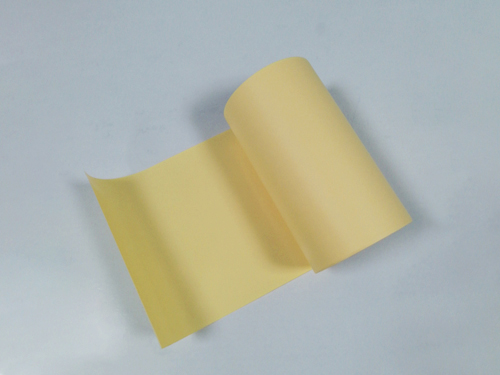
Glassine is a dense, smooth, translucent paper that takes silicone evenly and lays very flat, which makes it a default for labels, tapes, and graphic arts. Its smoothness and grease resistance come from compressed fibers rather than a coating, so it stays recyclable in standard paper streams (ScienceInsights, 2026). Glassine liners commonly measure about 50 to 70 microns thick (Clear Print, 2022).
That flatness matters more than buyers expect. A liner that lays flat feeds cleanly through converting and labeling equipment and accepts sharp, bright print. Glassine also resists fogging and hazing, and it does not shed fibers the way standard paper does, which keeps the adhesive and facestock clean. For most general-purpose label work, glassine is the starting point.
Super-calendered kraft (SCK) release liner
Super-calendered kraft is kraft paper polished under heat and pressure until it is smoother than standard kraft, and that smoothness plus broad applicator compatibility makes SCK a United States standard for product labels (Blue Label Packaging, 2026). It is usually bleached white and is built to run on the wide range of applicators common in North America.
SCK sits between glassine and film on performance and price. It is tougher than glassine, smooth enough for clean silicone holdout, and compatible with most label lines, which is why it shows up in high-volume product labeling. When a converter wants one reliable paper liner that runs across many jobs and machines, SCK is frequently the answer.
PET film release liner
PET film is a polyester release liner chosen for strength, thinness, and wet-application performance. It runs far thinner than paper, reaching as thin as 23 microns, or roughly 0.0009 inches, so a roll holds 20% to 30% more labels, which cuts roll changes and freight (Clear Print, 2022).
Film wins where paper struggles. PET is stronger and breaks less often on high-speed automatic labelers, it handles wet application such as chilled beverage cans, and its tight caliper control suits critical thickness specs. The trade-offs are cost and sustainability, since film carries a higher price and its recycling pathways are still developing, although they are improving (Clear Print, 2022). For high-speed, wet, or thickness-sensitive jobs, PET earns its premium.
Poly-coated kraft release liner
Poly-coated kraft, also called polykraft, is kraft paper with a polyolefin layer that adds a moisture barrier and dimensional stability while keeping the economics of a paper liner. It sits as a midpoint between plain paper and PET film (Blue Label Packaging, 2026).
The polyolefin coating makes polykraft the choice for humid or cold conditions where a plain paper liner would absorb moisture and lose stability. Wine labeling is the classic example, since the bottles face condensation and refrigeration. Polykraft gives converters that already run paper liners the moisture resistance they need without moving all the way to film.
Release liner types compared (chart)
The table compares the four main release liner types on the factors that drive a sourcing decision. Match the type to the adhesive, the line speed, and the environment rather than to price alone (Clear Print, 2022).
| Type | Base | Key strength | Typical caliper | Best for |
| Glassine | Paper | Smooth, flat, recyclable, sharp print | ~50 to 70 microns | Labels, tapes, graphic arts |
| Super-calendered kraft (SCK) | Paper | Polished, wide applicator fit, US standard | Varies by grade | High-volume product labels |
| PET film | Film | Thin, strong, wet and high-speed jobs | As thin as ~23 microns | Beverage, high-speed lines, thickness-critical |
| Poly-coated kraft | Paper + polyolefin | Moisture barrier, stable, paper economics | Varies by grade | Wine labels, humid or cold conditions |
How do you choose the right release liner type?
Start with the application line and environment, then match the base, the silicone system, and the caliper. Paper liners (glassine, SCK, polykraft) win on cost and print for standard label and tape work. Film (PET) wins on speed, wet application, and tight thickness control. The wrong type raises stoppages, scrap, and cost, so the choice is worth confirming before the first run (Clear Print, 2022).
A short selection guide:
- General labels and graphic arts: glassine for flatness and sharp print.
- High-volume product labels across many machines: SCK for applicator compatibility.
- High-speed, wet, or thickness-critical jobs: PET film for strength and thinness.
- Humid or cold environments on a paper budget: poly-coated kraft for the moisture barrier.
- Always specify base, silicone coat (single or double-sided), caliper, width, and core, and confirm minimums.
For the broader distinction between release liner and release paper, see our guide on release liner vs release paper. Kangchuang Paper manufactures silicone release paper and coated paper in custom widths and grades, with free samples and fast turnaround. To match a liner type to your line, request a quote or free sample.
FAQ
What is the most common release liner type?
Paper liners are the most common, and within paper, glassine and super-calendered kraft (SCK) lead for labels. SCK is a United States standard for product labels because it fits most applicators (Blue Label Packaging, 2026). Paper holds the largest share of the global release liner market overall (Verified Market Research, 2024).
What is the difference between glassine and SCK release liner?
Glassine is a dense, very flat, translucent paper ideal for sharp print and general labels. Super-calendered kraft is polished kraft that is tougher than glassine and compatible with a wide range of applicators, which makes it a standard for high-volume product labels (Blue Label Packaging, 2026). Both are paper liners.
When should you use a PET film liner instead of paper?
Use PET film for high-speed automatic labeling, wet application such as chilled beverage cans, and jobs with tight thickness specs. PET runs as thin as 23 microns and holds 20% to 30% more labels per roll than paper, with fewer breaks on fast lines (Clear Print, 2022). Paper remains the better value for standard label and tape work.
What is poly-coated kraft (polykraft) release liner?
Poly-coated kraft is kraft paper with a polyolefin layer that adds a moisture barrier and dimensional stability while keeping paper-liner economics (Blue Label Packaging, 2026). It is a midpoint between plain paper and film, used for wine labels and other humid or refrigerated conditions where plain paper would absorb moisture.
Are release liners recyclable?
Paper liners such as glassine are made from renewable fiber and glassine recycles in standard paper streams (ScienceInsights, 2026). Recycling silicone-coated liner is more complex than recycling plain paper, and PET film recycling is still developing, so confirm what your supplier or a regional liner-recycling program accepts.
Can release liner types be cut to custom widths?
Yes. Specialty manufacturers slit each liner type to the exact width and core your applicator needs, rather than forcing standard rolls. Confirm slitting tolerance, silicone coat weight, and minimum order quantity in your RFQ, since these vary between large mills and dedicated specialty suppliers.