Aller au contenu
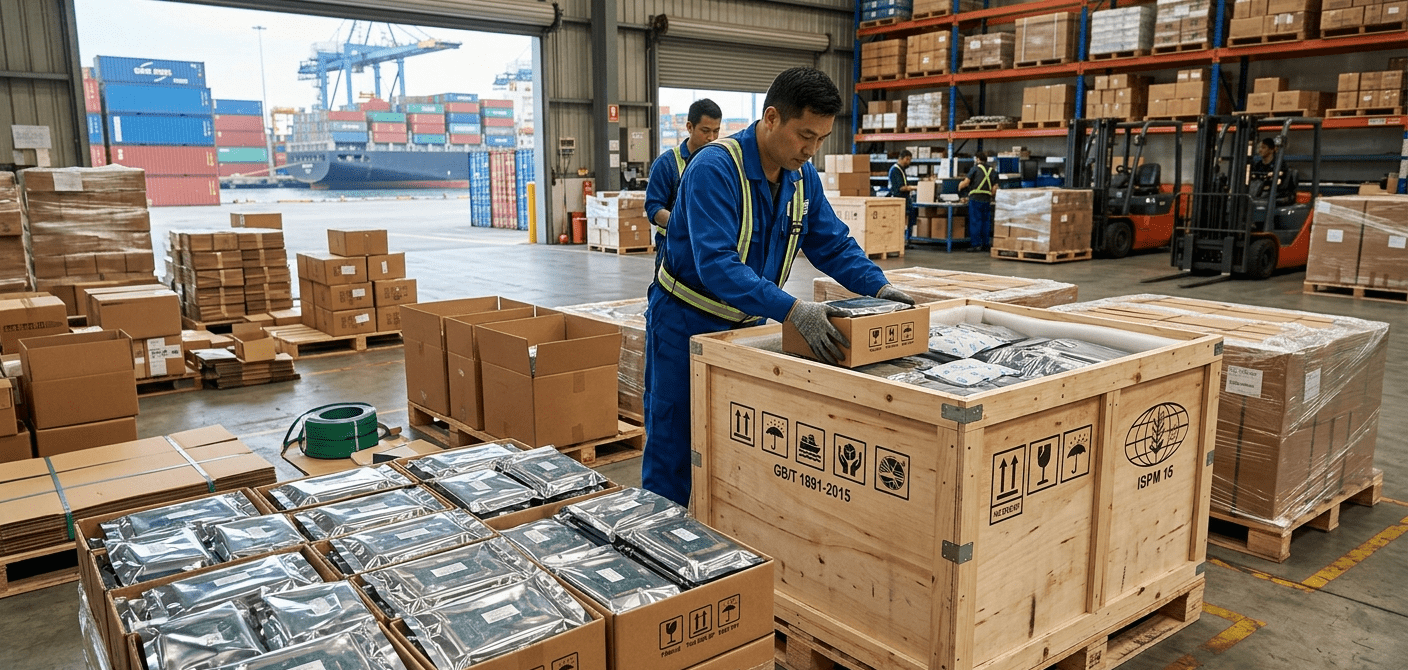
Ocean freight transit from Asia to the United States or Europe takes 20–35 days. During that time, your circuit boards experience humidity cycling, temperature variation, salt-air exposure, vibration, and compressive stack pressure. Boards that arrive with tarnished pads, ionic contamination failures, and induced warpage are almost always the result of incorrect packaging — not a manufacturing defect.
This guide covers the complete packaging protocol for bare PCBs and populated PCBAs for ocean freight transit — specifically the materials, stacking procedure, and documentation that prevents the three most common failure modes: chemical contamination from packaging paper, moisture-induced ionic contamination, and mechanical warpage from incorrect stacking.
The Three Failure Modes of Incorrectly Packaged PCBs in Ocean Freight
1. Chemical Contamination from Packaging Paper
Standard paper (kraft, newsprint, corrugated separator board) contains sulfur compounds that release H₂S gas in the package environment. Over 20–35 days of ocean transit, this H₂S concentrates inside sealed packaging and reacts with copper pads, gold-plated edge connectors, and solder alloys — producing metal sulfide tarnish that fails solderability acceptance tests at incoming inspection.
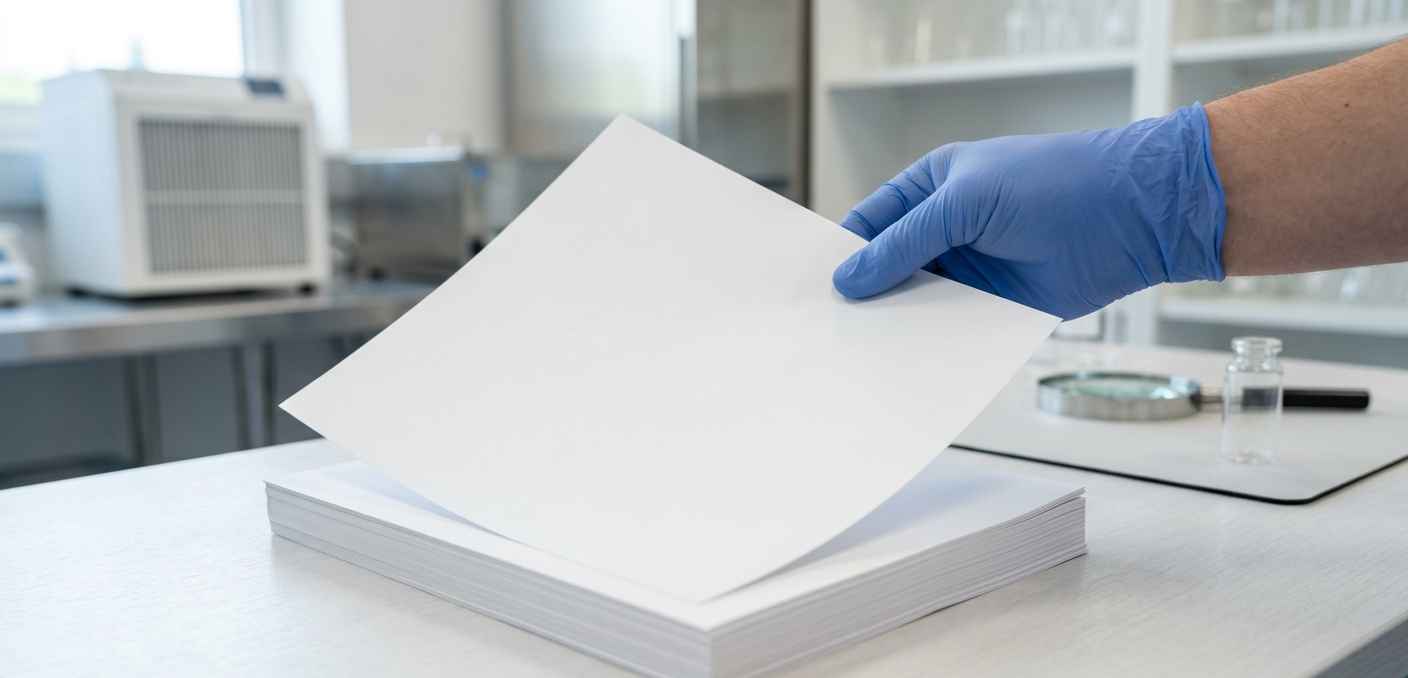
The fix: replace all paper that contacts or surrounds circuit boards with sulfur-free, acid-free separator paper (<5ppm sulfur, pH 7.0–8.5).
2. Moisture-Induced Ionic Contamination
Ocean freight containers experience significant humidity variation — particularly in the tropics and during day/night temperature cycling that causes condensation. Paper packaging materials absorb and release moisture, contributing to the package humidity environment. High humidity during transit activates residual ionic contamination on PCB surfaces (flux residues, handling contamination), increasing ionic contamination levels measured by ROSE or SIR testing at incoming inspection.
The fix: use moisture barrier bags (MBBs with desiccant) as the primary moisture seal around stacked boards, with the separator paper inside the MBB. The paper sees no external humidity cycling.
3. Mechanical Warpage from Stacking Pressure
Thin multilayer PCBs (1.0–1.6mm, large panel dimensions) are susceptible to warpage when stacked under compression for extended transit periods. Uneven pressure distribution — caused by separator paper with inconsistent caliper, or by rigid separators that concentrate stress at board edges — induces warpage that causes placement failures at SMT assembly.
The fix: use separator paper with consistent caliper (±5% across sheet area) and appropriate stacking depth limits (typically 10–15 boards per stack for 1.6mm FR4).
Required Packaging Materials for Ocean Freight PCB Shipping
- Sulfur-free, acid-free separator paper sheets: Cut to PCB panel dimensions (±2mm). Use 60–80gsm for standard 1.6mm bare boards; 50–60gsm for populated PCBAs. One sheet between every board in the stack.
- Moisture barrier bags (MBB): Heat-sealable aluminum foil laminate bags rated for at least 0.01 g/m²/day water vapor transmission rate (WVTR). Size to fit the board stack plus desiccant with adequate sealing margin.
- Silica gel desiccant: 4–6 units (30g each) per MBB depending on board area and expected transit humidity exposure. Use indicating desiccant (color-change) so incoming inspection can verify desiccant condition.
- Humidity indicator card (HIC): Place inside each MBB before sealing — provides visual record of maximum humidity reached during transit for incoming inspection documentation.
- Foam sheets or edge cushions: For thin boards and large panels: foam cushioning on the top and bottom of each board stack in the carton, and optional edge foam to prevent edge impact damage.
- Export cartons: Double-wall corrugated carton rated for the stacked board weight. Carton should not compress more than 3mm under the compressive load of the column stack in a full pallet.
Step-by-Step PCB Packing Procedure for Ocean Freight
- Cut separator paper sheets to PCB panel dimensions. Verify dimensions are within ±2mm of the board size — oversized sheets that fold at board edges concentrate stress on edge features.
- Inspect each board before packing — visual inspection for manufacturing defects, surface cleanliness, and pad condition. Do not pack boards with visible contamination.
- Place one separator sheet on a clean flat surface. Place the first board face-down on the separator sheet. Place a second separator sheet on top of the board. Place the next board, and continue alternating board and separator sheet throughout the stack.
- Limit stack depth to 10–15 boards for 1.6mm boards; 8–10 boards for boards above 250×300mm panel size; 5–7 boards for thin boards below 1.0mm. Heavier multilayer boards warrant tighter stacking limits.
- Place the completed stack in a moisture barrier bag. Add silica gel desiccant (4–6 units) and a humidity indicator card beside the stack. Seal the MBB with a heat sealer — two sealing passes for reliable closure.
- Label the sealed MBB: PCB part number, layer count, board quantity in stack, packing date, and ‘Open only in ESD-controlled environment.’
- Place sealed MBBs into export carton with foam cushioning between MBBs. Fill void space to prevent movement during transit. Close and seal carton.
- Carton label must include: part number, revision, quantity, gross/net weight, fragile indicator, and orientation arrows. Stack cartons on pallet with heaviest at bottom, maximum 4 cartons high.
Separator Paper Specification for Ocean Freight
The separator paper specification for ocean freight PCB packaging differs slightly from domestic transit packaging because of the extended transit time and environmental exposure. For ocean freight, use:
- Sulfur content: <5ppm — verified by batch XRF test report. Specify this explicitly to your paper supplier and require the test report.
- pH: 7.0–8.5 — acid-free with alkaline reserve for long-term storage stability.
- GSM: 60–80gsm for bare PCBs; 50–60gsm for populated PCBAs.
- Caliper uniformity: ±5% of specified gsm — essential for even pressure distribution in stacked boards.
- Cut dimensions: Board panel dimensions ±2mm — do not use oversized sheets.
- Surface: Smooth, low-lint — compatible with clean room handling at EMS facilities.
| Kangchuang Paper supplies PCB board separator paper to these exact specifications — <5ppm sulfur, pH 7.0–8.5, custom cut to your panel dimensions. Batch sulfur test reports included with every shipment. Free samples via DHL Express. → kangchuangpapers.com/product/pcb-board-separator-sulfur-free-paper/ |
Common Mistakes and How to Avoid Them
- Using corrugated board as PCB separator: Corrugated board is not acid-free or sulfur-free — it produces both acidic gases and H₂S that contaminate PCB surfaces. Never use corrugated as a separator between boards.
- Sealing MBBs without desiccant: MBBs without desiccant trap ambient humidity at the time of sealing inside the bag for the entire transit period. Always include fresh silica gel desiccant, sealed within the moisture barrier.
- Stacking too many boards: More than 15 boards in a 1.6mm stack can cause warpage on boards at the bottom from compressive weight. Limit stack depth and use appropriate separator paper stiffness.
- Not marking carton orientation: Boards stacked upright (on edge) in transit experience very different mechanical forces than boards stacked flat. Always mark ‘THIS SIDE UP’ with orientation arrows and verify cartons are stored correctly throughout the supply chain.
Frequently Asked Questions
How many boards can I stack with separator paper between each?
For 1.6mm FR4 bare boards (standard thickness): 10–15 boards per stack. For thin boards below 1.0mm: 5–8 boards per stack. For large-format boards above 400×400mm: maximum 8 boards per stack to limit total stack weight. Reduce limits for boards with BGA components or other fragile surface features.
Do I need separate MBBs for each stack or can I combine multiple stacks?
Each stack should be in its own MBB with adequate desiccant for the board count in that MBB. Combining multiple stacks in one large MBB reduces desiccant effectiveness (desiccant may be saturated before arrival) and makes incoming inspection and stack separation more difficult.
Is vacuum packaging better than MBBs with desiccant for PCB ocean freight?
Vacuum bags (vauum-sealed MBBs) are preferred for ESD-sensitive and moisture-sensitive components because they eliminate all air (and thus all moisture) from the package. For standard PCBs, MBBs with desiccant are the normal specification. Vacuum sealing is recommended for fine-pitch BGA boards and boards that have recently been through wave soldering (which can increase board moisture absorption).
Can I use standard kraft paper if I put boards in MBBs first?
If the boards are in a sealed, properly desiccated MBB, external separator paper between MBBs (used to prevent MBB-to-MBB abrasion in the carton) can be standard paper — because the MBB provides the chemical barrier. However, any paper inside the MBB (between boards) must be sulfur-free.