Aller au contenu
A release liner and release paper describe the same core product: a silicone-coated carrier sheet that keeps an adhesive from sticking before it is ready to use. The difference is scope. “Release liner” is the umbrella term for any backing, whether paper or plastic film, while “release paper” names a paper-based liner specifically. Paper holds the largest share of this market, which Grand View Research valued at $19.59 billion in 2025 and projects to reach $36.52 billion by 2033 (Grand View Research, 2025). Paper liners lead on cost and print sharpness, and Asia Pacific accounted for 35.1% of revenue in 2025 (Grand View Research, 2025).
What is a release liner?
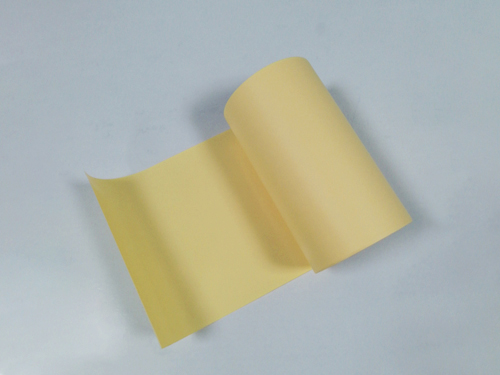
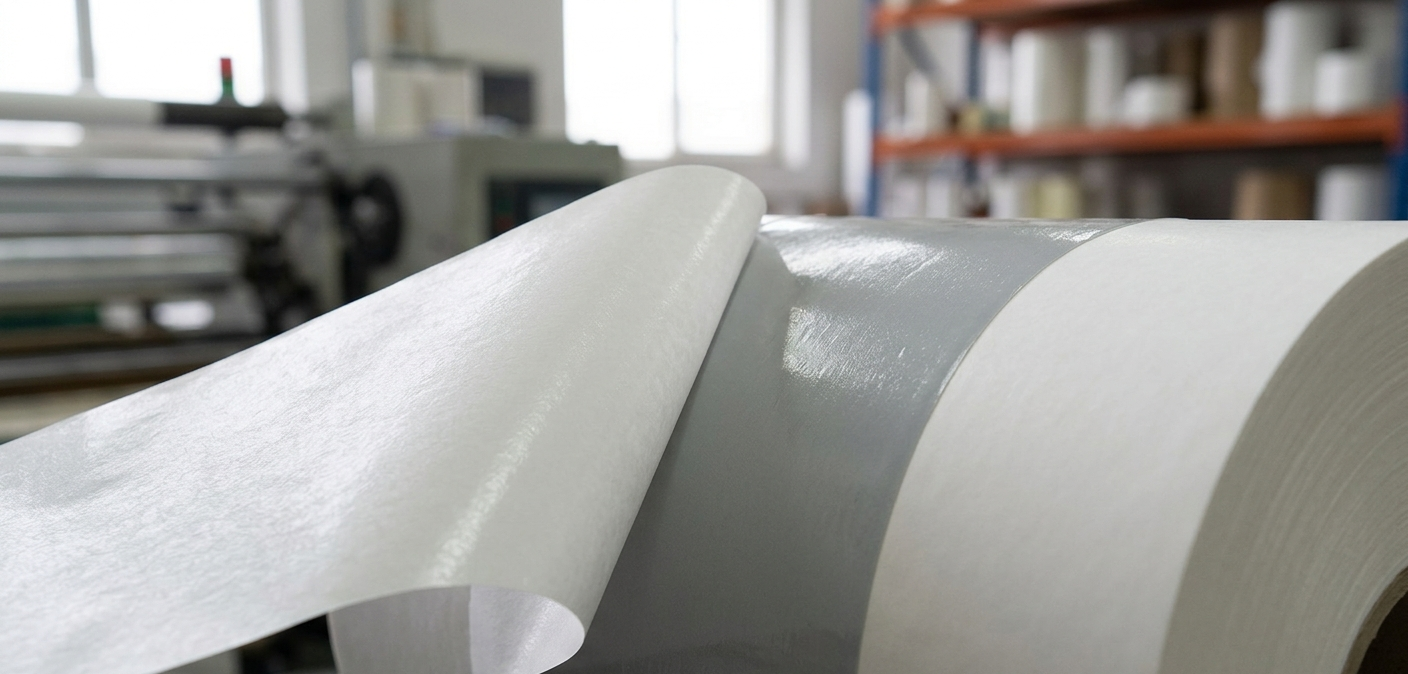
A release liner is a paper or film sheet coated with a release agent, usually silicone, that carries a pressure-sensitive adhesive until the moment of application. The coating lowers the surface energy so the sticky face peels away cleanly. Release liners appear in nearly every self-adhesive product, from shipping labels to surgical tapes (Loparex, 2023).
The liner does three jobs at once. It protects the adhesive from dust and damage, it stops layers from bonding to each other on the roll, and it acts as the carrier web that feeds labels through high-speed applicators. When a label dispenses smoothly on an automatic line, the liner is the part doing the quiet work behind it (Avery, 2024).
Is release paper the same as a release liner?
Yes, in everyday use the two terms point to the same product, with one distinction. Every release paper is a release liner, but not every release liner is paper. A release liner can be built on a paper base or a plastic film base such as PET, so “release paper” is the paper subset of the wider liner category (Wikipedia, 2025).
This matters when you write a spec or a purchase order. If you ask a supplier for “release paper,” you are signaling a paper substrate, which favors cost, printability, and a flat lay. If you ask for a “release liner” without naming the base, the supplier may quote either paper or film, and the two perform differently in moisture, speed, and thickness control (Channeled Resources, 2019). Naming the base up front removes guesswork and saves a sampling round.
Paper vs film release liners: which is right for you?
Paper liners win on cost, print quality, and lay-flat behavior, which is why the paper segment leads the global market (Verified Market Research, 2024). Film liners, usually PET, win on strength, thinness, and wet-application performance. PET runs thinner than paper, so a roll holds 20% to 30% more labels, which cuts changeovers and freight (Clear Print, 2022).
The decision usually comes down to the application line and the environment. Paper handles standard label and tape converting at a lower price and prints brighter, sharper graphics. Film handles high-speed automatic labeling, wet surfaces such as chilled beverage cans, and any job where breaks on the machine cost real downtime (Avery, 2024).
| Factor | Paper release liner | Film release liner (PET) |
| Relative cost | Lower | Higher |
| Print quality / ink holdout | Excellent, sharp | Good |
| Lay-flat | Excellent | Can curl less than paper but costs more |
| Thickness | ~50 to 70 microns (glassine) | As thin as ~23 microns |
| Labels per roll | Standard | 20% to 30% more |
| Wet / high-speed application | Limited | Strong |
| Sustainability | Renewable fiber, chain-of-custody available | Improving, recycling still developing |
What are the main types of paper release liner?
Paper release liners split into three workhorse substrates: glassine, super-calendered kraft (SCK), and poly-coated kraft. Each balances smoothness, strength, and moisture resistance differently, so the right one depends on the adhesive, the print method, and the conditions the label will face (Blue Label Packaging, 2026).
Glassine is a dense, smooth paper that takes silicone evenly and lays very flat, which suits labels and graphic arts. Super-calendered kraft is polished under pressure until it is smoother than standard kraft, and that smoothness plus broad applicator compatibility makes SCK a default for product labels in the United States (Blue Label Packaging, 2026). Poly-coated kraft, sometimes called polykraft, adds a polyolefin layer that resists moisture and adds stability, which is why it shows up in wine labels and other humid-environment jobs.
| Paper liner type | Key strength | Common use |
| Glassine | Smooth, flat, even silicone holdout | Labels, graphic arts, tapes |
| Super-calendered kraft (SCK) | Polished surface, wide applicator fit | Product labels, high-volume converting |
| Poly-coated kraft | Moisture barrier, dimensional stability | Wine labels, humid or cold conditions |
How is release liner weight and thickness measured?
Release paper is specified by basis weight in grams per square meter (GSM) and by caliper, the thickness measured in microns or mils. Glassine paper liners commonly run about 50 to 70 microns thick, while PET film liners reach as thin as 23 microns, or roughly 0.0009 inches (Clear Print, 2022). Thinner is not automatically better. The right caliper depends on the adhesive and the line speed.
Two liners with the same GSM can behave differently if one is calendered and one is not, because the surface finish changes how silicone sits and how the adhesive cures against it. When you benchmark suppliers, compare GSM, caliper, and silicone coat weight together, not weight alone. For a deeper walkthrough of paper weight ranges, see our kraft paper GSM chart.
Which industries use release liners?
Labels are the single largest application for release liners, and the segment is growing faster than the market overall (Grand View Research, 2025). Beyond labels, release liners carry adhesives in tapes, medical products such as wound dressings and transdermal patches, graphic arts, and electronics assembly (Persistence Market Research, 2026).
Electronics is a fast-rising end use. Component labels, die-cut adhesive parts, and protective films all rely on liners that release with consistent, repeatable force, because an inconsistent peel jams automated assembly. The same precision matters in medical converting, where the liner has to release cleanly without contaminating the adhesive. These higher-spec jobs are where a specialty manufacturer earns its place against commodity stock.
How do you choose the right release liner?
Start with the application line and work backward to the substrate. Match the base (paper or film), the silicone system (single or double-sided, standard or controlled release), the caliper, and any certifications your buyer requires. The wrong liner increases label-application stoppages, scrap, and cost, so the spec is worth getting right before the first production run (Clear Print, 2022).
A short checklist for your RFQ:
- Base: paper for cost and print, film for speed and wet jobs.
- Silicone: single-sided for most labels, double-sided or differential for tapes and transfer tapes.
- Caliper and GSM: set by line speed and adhesive, not by habit.
- Width and core: confirm the supplier slits to your applicator, not just standard rolls.
- Minimums: specialty suppliers often run smaller, tightly specified orders that large mills will not quote.
Kangchuang Paper manufactures silicone release paper and coated paper in custom widths and grades, with free samples and fast turnaround. If you are benchmarking a current liner or specifying a new one, request a quote or free sample and our team will match the substrate to your line.
FAQ
Is release paper the same as backing paper?
Yes. “Backing paper,” “carrier,” “liner,” and “release paper” all describe the silicone-coated sheet that holds an adhesive until use. The terms vary by region and industry, but the function is identical: carry the adhesive, then peel away cleanly. Paper bases lead the market because they cost less and print sharper than film (Verified Market Research, 2024).
Can you reuse a release liner after peeling the label?
In most cases no. Once the adhesive transfers off the liner, the silicone surface has done its job and the liner is treated as waste or sent for recycling. Some converters recover and recycle spent liner at volume, and non-silicone and recyclable coatings are an active area of development (Persistence Market Research, 2026).
Is glassine the same as release paper?
Glassine is one type of release paper, not a synonym for all of them. It is a dense, smooth, flat paper that accepts silicone evenly, which makes it popular for labels and graphic arts. Super-calendered kraft and poly-coated kraft are the other two common paper liner substrates (Blue Label Packaging, 2026).
What GSM is release liner paper?
Release paper is sold across a range of basis weights rather than one fixed GSM, with the right weight set by the adhesive and line speed. Caliper is often the more useful number: glassine liners commonly measure about 50 to 70 microns thick (Clear Print, 2022). Always confirm GSM, caliper, and silicone coat weight together.
Is release liner recyclable?
Paper release liner is made from renewable wood fiber and chain-of-custody certification is available to trace that fiber (Clear Print, 2022). Recycling spent silicone-coated liner is more complex than recycling plain paper, so check whether your supplier or a regional liner-recycling program accepts coated stock.
Does release paper come in custom widths?
Yes. Specialty manufacturers slit release paper to the exact width and core size your applicator needs, rather than forcing standard rolls. Confirm slitting tolerance and minimum order quantity in your RFQ, since these vary widely between large mills and dedicated specialty suppliers.