Ir para o conteúdo
Custom-width paper rolls are one of the most commonly purchased industrial paper products — and one of the most commonly mis-specified. Buyers who source through packaging distributors often accept whatever standard width is closest to their requirement, pay a markup over factory price, and still deal with tolerance and dimension inconsistencies.
Sourcing custom-width paper rolls directly from a fabricante de papel eliminates all three problems. This guide explains exactly how to specify what you need, what questions to ask, and what to expect from a factory-direct order.
What Is a Custom Width Paper Roll — and Why Do You Need One?
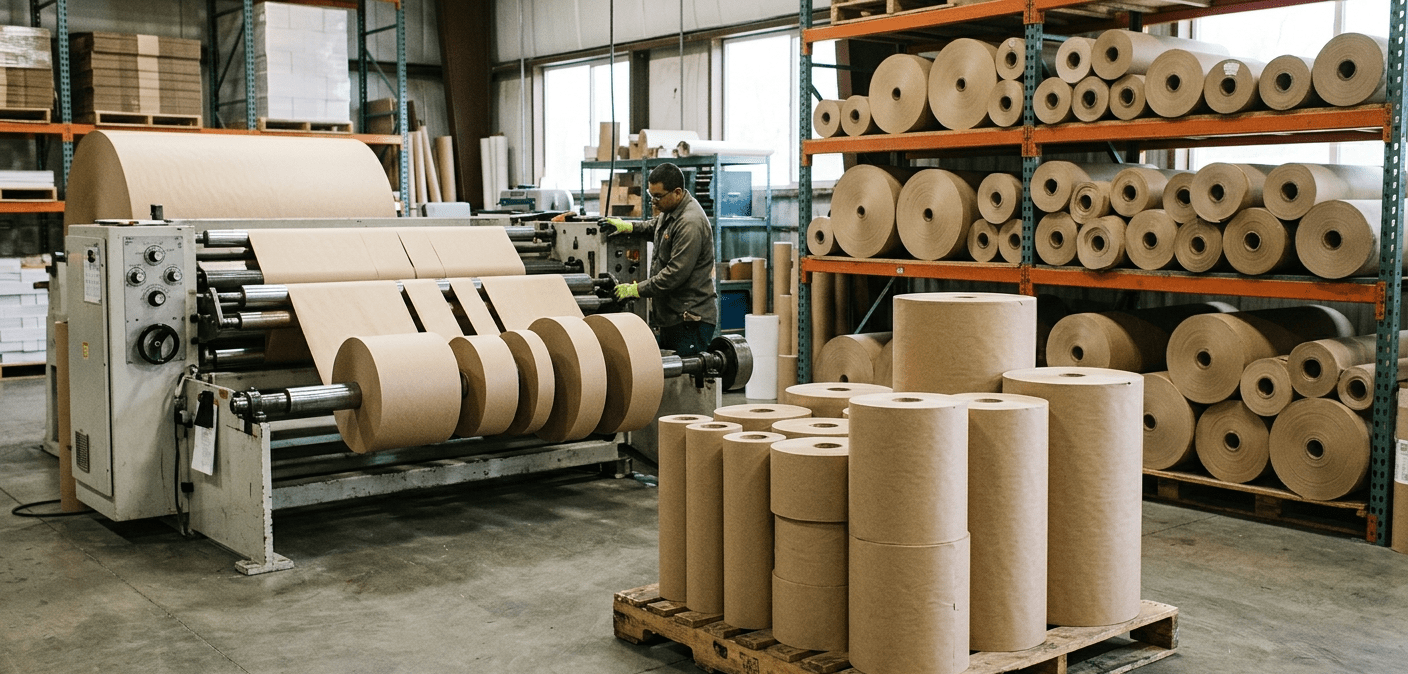
A custom width paper roll is a narrow paper roll produced by slitting a wide master roll to a specified width. Paper is manufactured on wide machines (1,400–2,400mm wide) and then slit to narrower widths on a separate slitting machine to match the specific application requirement of each buyer.
You need a custom width roll when: your packaging machine, labeling equipment, tape dispenser, component taping line, or automated system requires paper at a specific width that is not available as a standard commercial product — which is almost always the case for industrial applications.
Standard paper widths sold through distributors (typically A4, Letter, or a few standard roll widths) rarely match industrial equipment specifications. Your machine was engineered to a specific paper width for a reason — a roll that is 5mm too wide causes jams; 5mm too narrow causes misalignment and defective output.
The 7 Parameters You Must Define Before Ordering Custom Width Rolls
1. Paper Grade and Type
Specify the paper type: kraft (brown or white), newsprint, sulfur-free, antistatic, coated, recycled, or specialty grade. Different paper grades have different slitting characteristics and not all manufacturers slit all grades. Confirm your required grade is available before proceeding.
2. Paper Weight (GSM)
Grams per square metre — the weight of one square metre of paper. Higher gsm = heavier, thicker, stronger paper. Specify the exact gsm required for your application. If you are matching an existing product, weigh a known sheet at measured dimensions to back-calculate gsm rather than relying on a supplier’s label.
3. Slit Width
The width of the finished narrow roll in millimetres. Be specific: ’44mm’ not ‘approximately 44mm.’ Specify the width tolerance you require: ±0.5mm is achievable with precision razor blade slitting; ±0.3mm is achievable with additional calibration for carrier tape and precision applications. If your application is for a machine with a fixed feed slot, measure the slot dimension before specifying — the paper roll must be narrower than the slot, not equal to it.
4. Roll Length
The total length of paper wound on each roll, measured in metres. Longer rolls reduce the frequency of roll changes on your machine but require larger roll OD. Calculate your typical consumption rate (metres per hour or metres per shift) and choose a roll length that gives you a practical change interval — typically 2–8 hours for automated lines.
5. Core Inner Diameter
The inside diameter of the cardboard or plastic tube at the centre of the roll. Standard industrial core diameters are 3-inch (76mm) and 6-inch (152mm). Check your machine’s spindle or mandrel diameter — the core must match the spindle for correct reel mounting. Non-standard core diameters (25mm, 38mm, 50mm, 100mm) are available from most manufacturers on request.
6. Maximum Roll OD (Outside Diameter)
The maximum outer diameter of the finished wound roll. Your machine’s reel holder or bracket will have a maximum OD it can accommodate — specify this limit. If the roll OD exceeds the maximum, the roll cannot be mounted. If the roll OD is much smaller than the maximum, you are changing rolls more frequently than necessary.
7. Winding Direction (Inside vs Outside Wind)
Wind direction describes whether the paper’s usable face is wound toward the core (inside wind / wind in) or away from the core on the outside of the roll (outside wind / wind out). The correct direction depends on how your machine feeds the paper from the roll. Incorrect wind direction causes the paper to feed in reverse. If unsure, request both directions on your sample order to test on your machine.
How the Slitting Process Works — What Happens After You Place Your Order
When you place a custom width roll order with a paper manufacturer, here is what happens on their production floor:
- A master roll of the specified paper grade and gsm is selected from inventory and inspected for grade certification and surface quality.
- Razor blades are mounted on the slitting arbor at precisely calibrated positions corresponding to your specified width. For multi-width orders (multiple different widths from the same master roll), all blade positions are set simultaneously.
- A short trial cut produces initial narrow strips, which are measured with calibrated digital calipers. All widths must be within your specified tolerance before full production begins.
- The master roll is slit at production speed. Each narrow roll is simultaneously wound onto its own core at controlled tension, producing consistent roll hardness.
- Finished rolls are inspected for width, OD, and edge quality. Rolls that fail inspection are recycled — not shipped.
- Approved rolls are labeled (grade, gsm, width, roll length, batch, date) and packed for shipment.
What MOQs and Lead Times to Expect from a Factory-Direct Order
Sample orders: Most manufacturers accept minimum 2 rolls per width for sample evaluation. This is sufficient for machine compatibility testing and quality evaluation. Expect 5–10 day lead time for samples.
Production orders: Minimum order quantities vary by manufacturer and paper grade. Typical minimums are 500kg total weight across all specified widths. For commodity grades (kraft, newsprint), minimums may be higher. For specialty grades (sulfur-free, antistatic), minimums are typically lower as these are higher-margin products.
Lead times for production orders: 7–15 days for standard grades. 10–20 days for specialty grades (sulfur-free with antistatic treatment, PE-coated kraft) that require additional processing steps.
What Documentation to Request with Your Custom Roll Order
- Material specification sheet: Confirms paper grade, gsm, width, and roll length of the batch shipped.
- Width measurement record: Documents measured width at sample positions on finished rolls — confirms tolerance compliance.
- Batch certificate: Provides traceability from your rolls to the specific paper production batch.
- Test reports (for specialty grades): Sulfur content report (for sulfur-free paper), surface resistance test (for antistatic paper), pH certificate. These are required for incoming inspection at electronics manufacturers and for supplier qualification audits.
| Kangchuang Paper produces custom-width slit rolls from 5mm to 1,600mm in kraft, newsprint, sulfur-free, antistatic, and specialty grades. Minimum 2 rolls per width for sample evaluation. Free DHL Express delivery to USA addresses. → kangchuangpapers.com/product-category/paper-tape-slitting/ |
Perguntas frequentes
What is the narrowest custom width roll I can order?
5mm is achievable with precision razor blade slitting on paper grades up to 80gsm. For heavier paper (above 80gsm), the practical minimum is approximately 8–10mm due to mechanical stress on very narrow strips during rewinding. For ultra-narrow strips below 5mm, discuss with the manufacturer as specialized handling may be required.
Can I order multiple widths from the same paper grade in one order?
Yes — multi-width slitting from one master roll is standard practice and cost-efficient. Specify all required widths, roll lengths, and quantities in one inquiry. The manufacturer will set all blade positions simultaneously and produce all widths in a single production run.
How do I know if the width tolerance will be adequate for my machine?
Check your machine’s paper feed slot or reel guide width tolerance in the equipment manual. Compare it to the ±0.5mm standard slit tolerance. If your machine requires tighter tolerance (±0.3mm), request this explicitly — it requires additional blade calibration but is achievable on precision slitting equipment.
What is the difference between 3-inch and 6-inch cores?
3-inch cores are used in smaller, desktop-scale equipment and manual dispensers. 6-inch cores are standard for industrial production line equipment and large automated systems. If unsure, check the spindle diameter of your machine or measure the core tube of your current rolls.