跳到内容
跳到内容 
GSM — grams per square metre — is the single most important specification for kraft paper selection, and it is also the one most commonly guessed at or defaulted to when buyers do not have clear guidance. Choosing too light a kraft paper for your application results in tearing, jamming, and packaging failures. Choosing too heavy adds unnecessary material cost and can cause machine feeding problems on automated equipment.
This guide covers what gsm actually means, why kraft paper strength scales with gsm, and — most usefully — a specific gsm recommendation for every major kraft paper application you are likely to encounter.
What GSM Means — and What It Tells You About Kraft Paper
GSM (grams per square metre) is the mass of one square metre of paper, measured in grams. It is the universal standard paper weight specification used across the global paper industry — not to be confused with ‘weight per 1,000 sheets’ (M-weight) or ‘basis weight in pounds’ (used for some US paper specifications).
In practice, gsm tells you three things simultaneously about a paper:
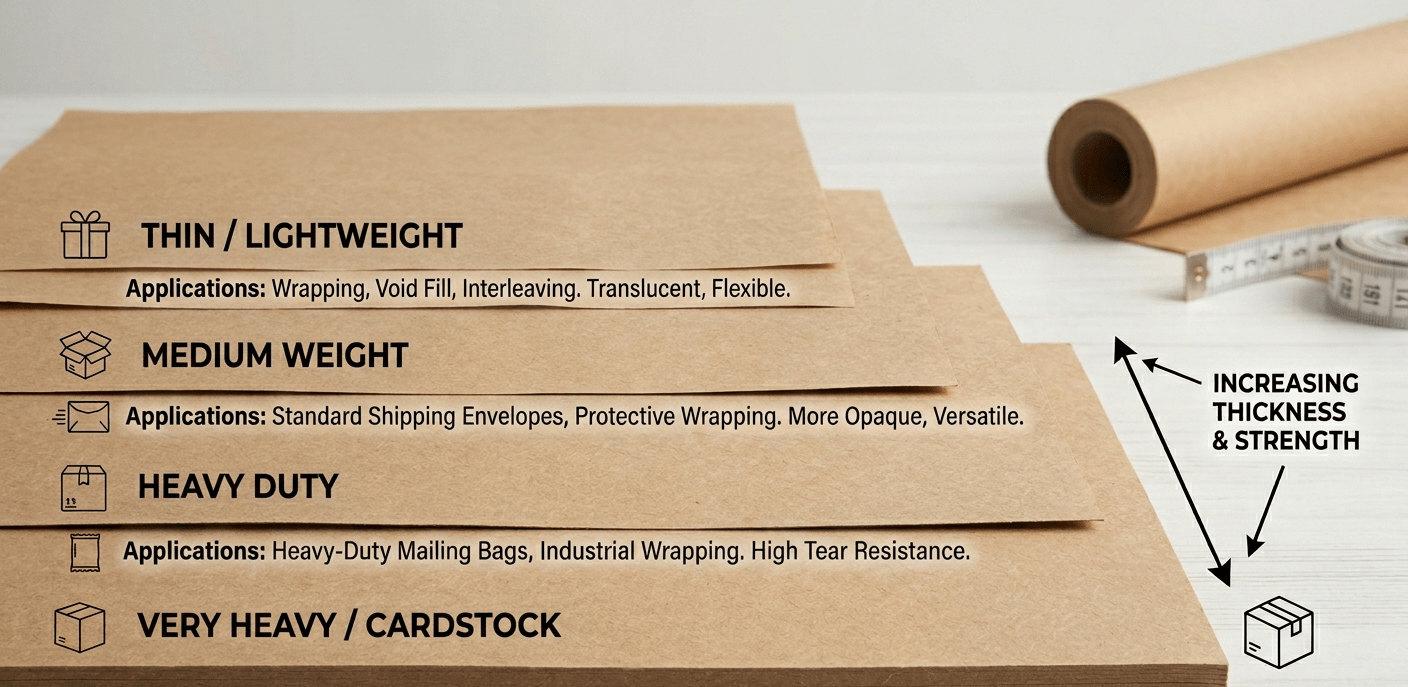
- Thickness (caliper): Higher gsm = thicker paper. For kraft paper, approximately 80gsm = 90–100μm caliper; 120gsm ≈ 130–150μm; 200gsm ≈ 220–260μm. Exact caliper depends on the manufacturing process and density of the paper.
- Strength: All else equal, higher gsm kraft paper has higher tensile strength, burst strength, and tear resistance. This is the primary specification driver for packaging applications — the question is always ‘how much strength do I need for this load and handling condition?’
- Opacity: Higher gsm = more opaque. At 60gsm, kraft paper is somewhat translucent. At 120gsm and above, it is fully opaque.
GSM does not tell you: paper type (brown vs white vs coated), fiber quality (virgin vs recycled), or special treatments (wet-strength, PE coating). These are separate specifications that you specify alongside gsm.
Kraft Paper GSM — Complete Application Guide
| GSM RANGE | TYPICAL CALIPER | APPLICATIONS | MACHINE COMPATIBILITY |
| 35–50gsm | 38–55μm | Interleaving between components, tissue-weight inner wrapping, carrier tape paper | Automated feeding, component taping machines — lightweight grade |
| 60–80gsm | 65–90μm | Standard industrial wrapping, paper bags (light goods), craft packaging, box liner | Most packaging machines, manual and automated wrapping |
| 90–120gsm | 100–135μm | Outer packaging wrapping, medium paper bags, furniture protection strips, garment packaging | Standard automated lines — most common industrial range |
| 150–200gsm | 160–220μm | Heavy-duty outer wrap, multi-layer bag construction, structural packaging | Heavy-duty lines, multi-ply bag machines |
| 250–300gsm | 270–330μm | Industrial sack manufacturing, heavy goods packaging (25–50kg loads) | Multi-ply sack machines, industrial converting lines |
Application-Specific GSM Recommendations
E-Commerce Shipping Wrapping (Outer Wrap)
Recommended: 80–90gsm brown kraft. This provides sufficient strength to wrap and protect products during parcel handling (drop from 1m, conveyor impact) without excessive material cost. Products above 3kg should use 90–100gsm. Products above 5kg should use 100–120gsm.
Paper Bags for Retail and Food Service
Recommended: 60–80gsm for single-layer grocery bags and food service bags (carrying capacity 2–5kg). For heavier-duty retail bags with handles and 5–10kg loads: 80–100gsm. The tensile strength of the bag handles is determined by the kraft gsm — undersized causes handle tear-out failures at point of sale.
Component Interleaving in Electronics
Recommended: 35–60gsm sulfur-free kraft or sulfur-free paper. The primary function is chemical protection (sulfur-free specification), not mechanical strength — thin, lightweight paper is preferred to minimize added bulk in component trays. For PCB separator applications: 60–80gsm provides better caliper uniformity and handling durability during manual packing.
Kraft Paper Strips for Automated Packaging Machines
Recommended: 50–80gsm depending on machine type and bundle size. Most paper-bundling machines (for produce, bakery, hardware) operate with 50–70gsm strips. Check the machine manufacturer’s recommended paper specification — they typically specify a minimum tensile strength (e.g., 3.0 kN/m MD) which translates to approximately 60–70gsm for standard brown kraft.
Void Fill (Crumpled Kraft)
Recommended: 60–80gsm brown kraft. For void fill applications, crumplability is more important than strength — but the paper must not tear during crumpling by hand or in a paper crumpler machine. 60gsm is the minimum for crumpler machine use without excessive web breaks; 80gsm provides better durability without meaningfully reducing crumple volume.
Industrial Hardware Wrapping (Transit Protection)
Recommended: 80–120gsm for individual hardware components (fasteners, small machined parts, brackets). For large metal components (castings, machined blocks): 100–150gsm outer wrap. For corrosion-sensitive metals requiring long-term storage: specify VCI kraft paper (volatile corrosion inhibitor treated) at equivalent gsm — a separate product category from standard kraft.
Paper Sacks for Industrial Bulk Goods (Cement, Chemicals)
Recommended: 80–100gsm per ply in multi-ply constructions (typically 3–5 ply for 25–50kg sacks). Industrial sack kraft must meet specific burst and tear strength requirements defined by the goods being packaged — always reference the relevant TAPPI or ISO standard for your product category.
Brown vs White Kraft: Does the Color Change the GSM Recommendation?
White (bleached) kraft is approximately 10–15% lower in tensile and tear strength than brown (unbleached) kraft at the same gsm, because the bleaching process partially degrades fiber bonds. In practice this means:
- For a 90gsm brown kraft application: specify 100gsm white kraft to achieve equivalent strength.
- For printable bag applications requiring white surface: use 90–100gsm white kraft rather than 80gsm brown kraft.
The strength difference is small enough that for most applications it is handled by rounding up one weight tier on white kraft vs the equivalent brown kraft specification.
How to Identify the Correct GSM If You Are Matching an Existing Product
If you are trying to match the gsm of an existing kraft paper roll you are using but do not know the specification, use this method:
- Cut an exact 100mm × 100mm square from the roll (use a sharp cutter and metal ruler for accuracy).
- Weigh the cut square on a laboratory balance to the nearest 0.1 gram.
- Multiply the weight in grams by 100 to get the gsm. Example: a 100×100mm square weighing 0.82g = 82gsm.
This field test is accurate to within ±3–5gsm and gives you the specification needed to order a matching grade from any manufacturer.
| Kangchuang Paper supplies industrial kraft paper in brown and white grades from 60gsm to 300gsm, in any roll width from 50mm to 1,600mm. Factory-direct pricing, free sample rolls to USA via DHL Express. → kangchuangpapers.com/product/kraft-paper/ |
Frequently Asked Questions
Does a higher gsm always mean better kraft paper?
No — higher gsm means more material per square metre, which means higher strength, weight, and cost. For applications where you need high strength (heavy bag construction, outer carton wrap for heavy goods), higher gsm is necessary. For applications where flexibility, crumplability, and low bulk are priorities (interleaving, void fill), lighter gsm is correct. Specify the minimum gsm that meets your application’s strength requirement.
What is the difference between kraft paper gsm and ‘basis weight’ in pounds?
Basis weight in pounds (used in US paper specification) measures the weight of 500 sheets of a standard size (which varies by paper category). It cannot be directly compared between categories. GSM is universal and directly comparable across all paper types. To convert US basis weight to gsm for kraft paper: multiply lb/ream basis weight by 1.48 approximately — but confirm the ream size used, as it varies.
Can I use 60gsm kraft for packaging heavy goods (above 10kg)?
60gsm is not typically sufficient for direct outer packaging of goods above 3–5kg unless used in multi-layer construction (3+ layers). For single-layer outer wrapping of goods above 5kg, use a minimum of 80gsm; for goods above 10kg, use 100–120gsm. For pallet wrapping and heavy industrial goods, 150–200gsm is standard.
Why does my current kraft paper tear in my packaging machine?
Tearing in packaging machines is usually caused by one of three issues: (1) the paper gsm is too light for the machine’s tension setting — increase gsm or reduce machine tension; (2) the roll core diameter is incorrect for the machine spindle, causing uneven unwinding tension; (3) the paper has been stored in high humidity, reducing tensile strength. Check all three before changing the paper specification.