 Skip to content
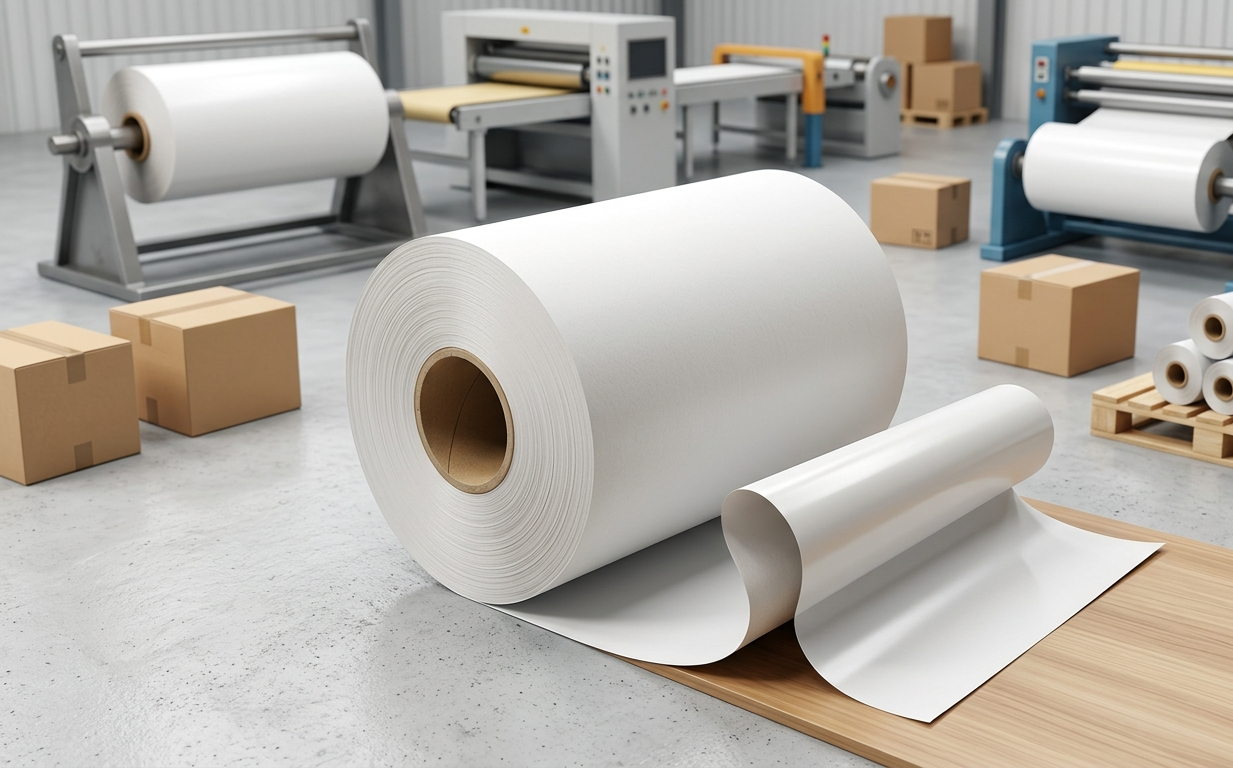
A silicone release liner is a paper or film backing coated with a thin, cured layer of silicone that lets a pressure-sensitive adhesive peel off cleanly. The silicone is what makes the backing “non-stick.” Tune how much goes on and how it cures, and you set exactly how easily the label, tape, or film lets go.
Peel a label off its backing. Hear that soft crackle? That’s a silicone release liner doing its one and only job letting go at precisely the right instant. Feels trivial. It isn’t. Buy thousands of rolls for a living, watch one batch release unevenly, jam an applicator, and stop a line mid-shift, and suddenly that thin invisible coating is the most important thing in the whole laminate.
Silicone-coated paper hides under a staggering slice of everyday products. Every self-adhesive label. Medical dressings. Graphic films. Industrial die-cut parts. All of it leans on the liner. And because the liner is cheap and out of sight, buyers routinely under-spec it, then act surprised when release goes sideways. So let’s fix that. What the silicone actually does, how the coating choices change everything, and how to spec a liner that behaves the same on roll one and roll ten thousand.
What the Silicone Layer Does
Pressure-sensitive adhesives are engineered to stick to nearly anything. Which is the problem. To store and handle one, you need a surface it’ll cling to gently and then walk away from without a struggle. That surface is silicone. Cured onto the liner, it forms a low-surface-energy skin the adhesive can’t get a real grip on. Clean release, every time that’s the goal, anyway.
The whole craft is in the tuning. Two levers do most of the work:
- Coat weight: how much silicone lands per unit area. More generally means easier, steadier release. Too little, and you get patchy high-release spots that drag.
- Cure quality: how fully the silicone cross-links during manufacturing. Under-cure it and the silicone can migrate onto the adhesive, contaminate it, and wreck performance three steps downstream.
Those two variables explain most of the complaints that ever reach a converter. A well-made liner releases the same across the entire web. A poorly cured one releases fine here, drags there, and nobody on the floor can tell you why until someone checks the coating line.
Silicone-Coated Paper Options
You can lay silicone over several base papers, and the base shifts cost, smoothness, and how the coating settles.
| Silicone-coated base | Character | Typical use |
| Silicone-coated glassine | Very smooth, tight release control | Labels, medical, food |
| Silicone-coated kraft (SCK) | Strong, economical | Tapes, industrial labels |
| Clay-coated kraft (CCK) + silicone | Smooth surface, good hold-out | Premium labels |
| Poly-coated kraft + silicone | Moisture-stable | Industrial, humid environments |
| Silicone-coated PET film | Dimensionally stable, clear | Precision die-cutting, electronics |
Glassine is the smooth, controllable darling for labels. Kraft-based liners bring strength and value to tapes and rough industrial work. Film holds its dimensions where paper would stretch and wander. Weighing paper against film? Our release liner types guide walks the full picture.
Release Force: The Spec That Decides Everything
One number rules the spec sheet: release force. How hard you have to pull to separate the adhesive from the liner. And it’s a pairing silicone plus a specific adhesive which is exactly why “just give me an easy-release liner” is only half a request.
| Release class | Feel | Matched to |
| Premium / easy | Light, effortless peel | Delicate films, high-speed auto-apply |
| Standard | Balanced, controlled | General-purpose labels |
| Tight / controlled-high | Firm, resists peel | Aggressive adhesives, heavy tapes |
Put an aggressive adhesive on an easy-release silicone and the label lifts itself right there in the box. Flip it — a light adhesive on a tight liner — and the automatic applicator can’t peel it off to save its life. The fix never changes: hand your supplier the adhesive details and let them match the silicone level to it.
Silicone vs. Non-Silicone: When to Switch
Silicone is the default for good reasons. Reliable. Tunable. Plays nice with almost every adhesive. But it’s not universal. In some electronics and specialized medical work, even trace silicone migration is a dealbreaker, because it can foul contacts, coatings, or a bond you need to hold. That’s where non-silicone systems earn their higher price. We put them head-to-head in silicone vs. non-silicone release paper. The gist: stay silicone unless you’ve got a documented reason to jump ship.
Worth clearing up a naming muddle too. “Silicone paper,” “release paper,” “glassine” — people swap those terms around like they’re identical, and they aren’t, quite. Our explainer on release paper vs. silicone paper vs. glassine sorts out which word means what.
How to Specify a Silicone Liner Without Regret
After enough troubleshooting calls, these are the details I make buyers pin down before they order anything:
- Adhesive it must release: the single most important input. Release is a pairing, remember.
- Coat weight and cure standard: ask whether the supplier actually controls and tests these. That’s what drives consistency, batch to batch.
- Base substrate: glassine, kraft, clay-coated, or film — picked for smoothness, strength, or stability.
- Release side: single- or double-sided silicone, depending on whether you’re carrying adhesive on one face or two.
- Migration sensitivity: flag electronics or medical use up front, so the supplier can confirm cure quality or steer you to a non-silicone route.
- Caliper and roll length: thinner liners give more length per roll and fewer changeovers on the line.
Pin those six down and the liner stops being a variable you have to babysit.
Where Silicone Liners Do Their Work
The application list reads like a tour of ordinary life. Price stickers on every retail shelf. Packaging and industrial tapes. Vinyl and graphic films on signs and vehicles. Wound dressings and transdermal patches. Hygiene products. Precision die-cut electronic components you’ll never lay eyes on. Each market leans toward a particular base and release class, and a supplier working across several of them — like our release paper operation — can usually recommend a proven grade instead of starting you from a blank sheet.
Storage and Handling: Protecting the Coating Before You Use It
Here’s the part people skip. A silicone liner can be perfectly manufactured and still let you down if it’s mishandled before it ever reaches your line. That cured silicone surface is thin, and it reacts to its surroundings. Heat and humidity swings nudge the release behavior, so rolls that baked near a summer loading dock won’t necessarily match rolls kept in a climate-controlled room down the hall. Contamination is the other silent gremlin — dust, plasticizers creeping over from nearby materials, a fingerprint from someone handling rolls bare-handed. Any of those can leave a localized high-release patch that shows up later as a skip in dispensing. The habits that prevent it aren’t complicated: keep rolls in their original wrap until use, store them flat or well supported so they don’t crush or telescope, rotate stock so the old rolls go first, and keep them clear of heat and volatile chemicals. Treat the liner as the precision component it actually is — not scrap backing — and it hands back the batch-to-batch consistency you paid for.
There’s a reason silicone-coated paper has held the industry standard for decades. Nothing else stacks this much tunability, reliability, and low cost into one thin layer. Spec it on purpose — coat weight, cure, base, and release class all matched to your adhesive — and you’ll never have to think about that soft crackle again.
Frequently Asked Questions
What does the silicone coating on a release liner actually do?
It lays down a thin, low-surface-energy layer that an adhesive can rest against but can’t grip hard, which is what lets a label or tape peel off cleanly and predictably instead of tearing. Dial the amount of silicone and the completeness of the cure, and you set the exact release force. Take that coating away and a pressure-sensitive adhesive would bond permanently to its own backing — impossible to dispense. So yes, the silicone is genuinely the functional heart of the whole liner, not a nice-to-have.
Why does my silicone liner release inconsistently across the roll?
Almost always it traces back to the coating stage: uneven coat weight or incomplete curing during manufacturing. Where less silicone landed, the release runs harder. Where the silicone is under-cured, it can transfer onto the adhesive and drag. That’s a quality-control problem baked in before the roll ever shipped — not something you can dial out on your own line. The real fix is sourcing from a supplier who measures and controls coat weight and cure, and holds those numbers steady batch after batch.
Can silicone from the liner contaminate my adhesive or product?
It can, if the silicone is under-cured, because loosely bound silicone may migrate onto the adhesive or the product surface. In most labeling that’s harmless and nobody notices. In electronics and certain medical uses, though, even a trace can interfere with bonding, coating, or electrical contacts — and there it’s a real defect. That’s exactly why properly cured liners matter so much, and why some sensitive applications drop silicone entirely for a non-silicone system. Flag any migration worry to your supplier before you place the order, not after.
Is silicone-coated glassine better than silicone-coated kraft?
Neither is flat-out better — they’re built for different jobs. Glassine is prized for a very smooth surface and tight, precise release control, which makes it the pick for labels, medical, and food work. Kraft is stronger and cheaper, so it suits tapes and industrial labels where ruggedness beats a glassy finish. Reach for glassine when smoothness and controlled release lead the spec, and kraft when strength and cost lead it. If you’re genuinely torn, the deciding factor is usually how delicate the end application is.
How do I choose the right release force for a silicone liner?
Don’t pick a release number in a vacuum — work backward from the adhesive and the application method, because release force only means anything as a pairing between the two. An aggressive adhesive, or a high-speed automatic applicator, needs a specific window just to dispense without lifting or jamming. Give your supplier the adhesive type and your dispensing setup, then let them test-match the silicone coat weight. The “right” value falls out of that combination, which is why a number that works for one shop fails at the next.
*Sourcing silicone-coated liners for labels, tapes, or die-cutting? See our release paper capabilities and full release paper range.*
About the Author
Ashley Zack — Technical Content Lead, Kangchuang Papers
Ashley Zack has spent over a decade around industrial and specialty paper from mill-floor production to advising packaging engineers and procurement teams on grade selection. At Kangchuang Papers, they translate hands-on manufacturing experience into practical, jargon-free guidance for buyers sourcing kraft, release, newsprint, and anti-corrosion papers. When a spec sheet and a real-world packing line disagree, they’ve usually seen why firsthand.
Have a sourcing question or a grade you can’t pin down? Get in touch with the Kangchuang Papers team.


