Zum Inhalt springen
For brand managers specifying packaging substrate for a new product line, choosing between kraft paper and corrugated cardboard without understanding the structural performance difference at your specific product weight and drop height is how brands end up with 8% damage rates in transit — and a packaging refresh cost of $40,000–$120,000 when the product fails retail shelf expectations. Corrugated outperforms flat Kraftpapier at impact and compression protection in virtually every transit application above 2 kg. But for wrapping, void fill, carrier bags, and retail-facing packaging where compression strength is not the design requirement, corrugated’s structural cost premium delivers nothing.
The kraft paper vs corrugated decision is not a quality question — both substrates can be high quality. It is a structural engineering question: what load and impact conditions will the packaging face, and what is the most cost-effective substrate that meets those conditions without over-engineering. Getting this right reduces material cost, freight cost (lower weight), and packaging waste — three variables that matter simultaneously to sustainability-committed brands in 2026.
This guide covers the structural and cost differences between kraft paper and corrugated, the specific applications where each wins, a substrate selection decision matrix, and how to verify the right specification before committing to a packaging run.
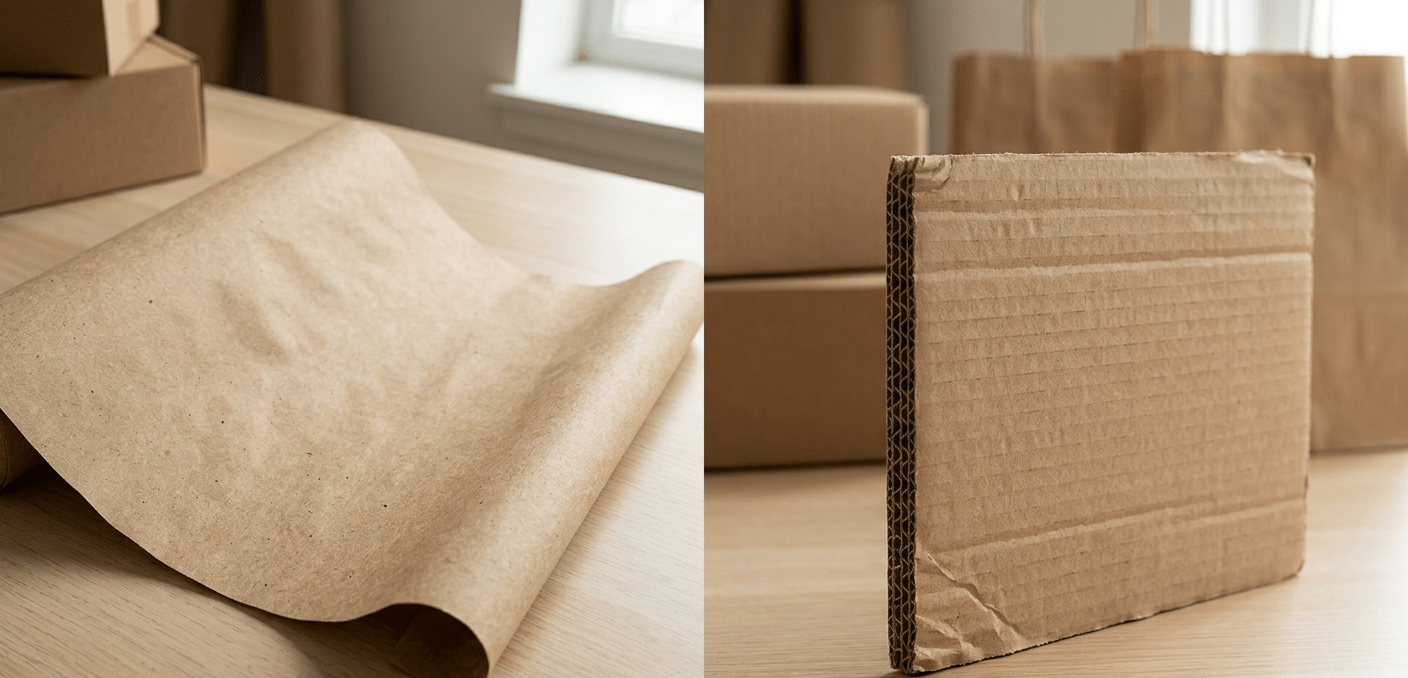
Kraft Paper vs Corrugated Cardboard: Core Structural Differences
| Property | Kraft Paper (flat sheet) | Corrugated Cardboard (single/double wall) |
|---|---|---|
| Structure | Single flat ply, 40–180 GSM | Linerboard + fluted medium + linerboard (sandwiched) |
| Caliper (thickness) | 0.05–0.25 mm | 3–7 mm (single wall) / 7–12 mm (double wall) |
| Compression strength | Low — limited by flat sheet rigidity | High — arch structure of flutes distributes load |
| Impact/drop resistance | Low — no cushioning layer | High — fluted medium absorbs impact energy |
| Weight per m² | 40–180 g/m² | 400–1,000+ g/m² (all layers combined) |
| Cost per m² (indicative) | $0.08–$0.25/m² | $0.35–$0.90/m² (single wall) |
| Printability (surface) | Good — smooth surface for flexo/offset | Moderate — corrugated surface limits fine detail print |
| Recyclability | Excellent — single material stream | Excellent — all layers fibre-based |
| FSC availability | Yes — widely available | Yes — linerboard FSC certified |
| Moisture resistance | Low unless coated | Low unless treated linerboard |
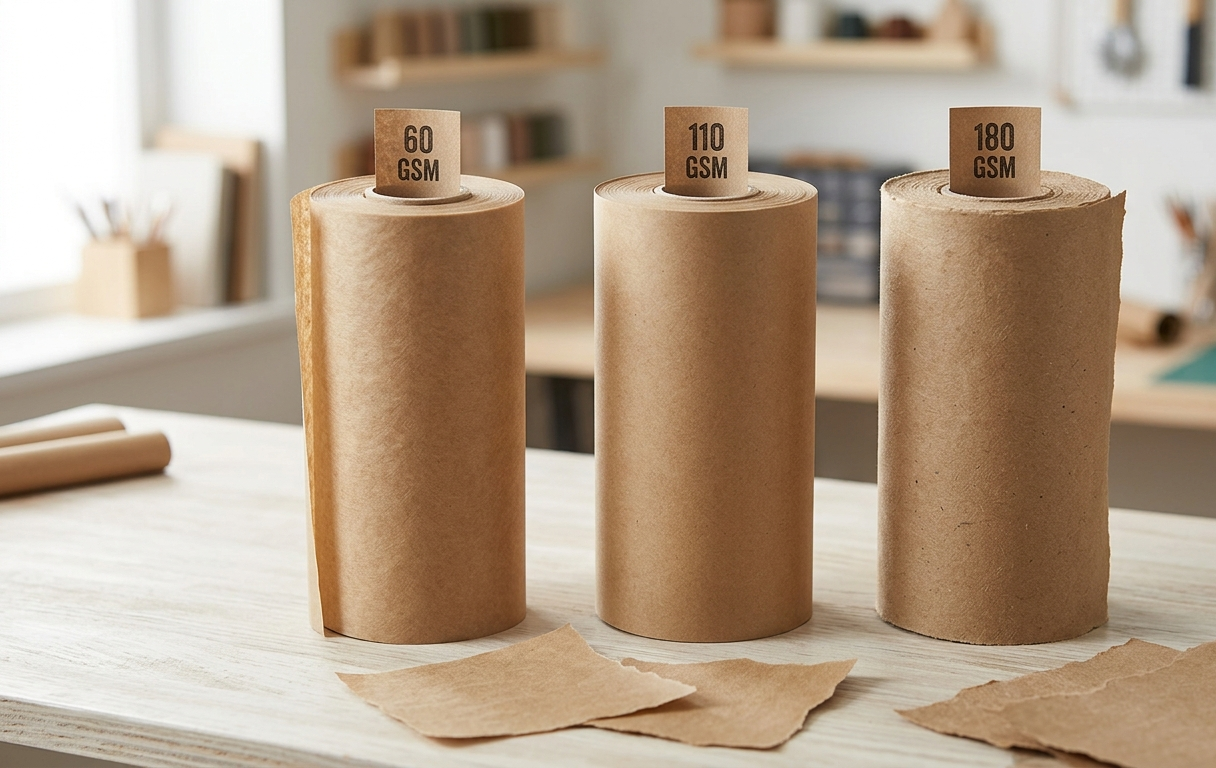
Kangchuang Papers supplies unbleached kraft in 40–180 GSM for wrapping, void fill, carrier bags, and retail-facing packaging applications. For customers evaluating substrate options, our team can provide samples and GSM-specific cost comparisons at kangchuangpapers.com.
Where Kraft Paper Wins: 6 Applications Where Flat Is Better
1. Void Fill and Cushioning Wrapping
Crumpled or honeycomb-cut kraft paper is the dominant sustainable void fill material in e-commerce packaging — replacing polystyrene peanuts and bubble wrap for most applications under 3 kg product weight. 90–120 GSM unbleached kraft provides adequate cushioning when crumpled and is FSC-certifiable for brands with sustainability commitments. Cost: $0.08–$0.15 per unit for a standard e-commerce box fill. Corrugated is not a substitute here — its structure does not crumple into effective cushioning.
2. Retail Carrier Bags
Brown kraft carrier bags (120–180 GSM) are the standard sustainable retail bag format for fashion, food, and gift retail. The flat kraft sheet is twisted, glued, and formed into bags — corrugated has no structural role in this application. FSC-certified 120–160 GSM unbleached kraft is the most common specification for branded retail bags meeting PEFC or FSC certification requirements.
3. Wrapping Paper for Fragile Items (Light)
70–90 GSM kraft paper wrapping provides surface protection and aesthetic presentation for light fragile items (glassware, ceramics under 500g) when the outer corrugated shipping box provides structural protection. Kraft wrapping is the inner layer — it does not need compression strength because the corrugated outer box provides it.
4. Butcher Paper and Food Service
White or natural kraft in 35–50 GSM food-grade specification is the standard for butcher paper, deli wrapping, and food service wrapping applications. FDA food-contact compliance (21 CFR 176) and grease resistance are the specification requirements — corrugated has no role in direct food contact packaging.
5. Pallet Wrapping and Interleaving
80–120 GSM kraft is used between product layers on pallets (interleaving) and for wrapping pallet loads. The application requires coverage, not structural strength — flat kraft is the cost-optimal substrate.
6. Branded Retail-Facing Packaging (Aesthetic Dominant)
Premium unboxing experience packaging — where the visible substrate is part of the brand communication — uses kraft paper for its natural texture and colour, often with flexo-printed branding. Corrugated’s scored and fluted surface does not accept fine print detail that flat kraft enables.
Where Corrugated Cardboard Wins: When You Need Structural Protection
1. Shipping Boxes for Products Over 2 kg
Any product above approximately 2 kg that will be palletised, stacked, or shipped through a courier or LTL freight network needs corrugated’s compression strength to survive transit without crushing. ISTA 2A and ISTA 6 transit testing protocols confirm that flat kraft paper cannot provide equivalent compression strength to single-wall corrugated (C or B flute) for this weight range.
2. Stacking and Warehouse Storage
Products stored in warehouse racking or stacked on pallets face compressive loads from the weight above them. Single-wall corrugated (32 ECT or higher) provides documented edge crush test (ECT) and box compression test (BCT) values that packaging engineers can spec to stack heights. Kraft paper has no equivalent structural specification for compression loading.
3. Fragile Items with Drop Requirements
Electronics, glassware, and instruments subject to a 91 cm (36 in) drop test require the fluted medium of corrugated to absorb impact energy. The arch geometry of the flutes acts as a cushioning layer that flat kraft cannot replicate. Double-wall corrugated (BC or EB flute) is typically specified for fragile electronics where the ISTA 2A drop test is required.
4. Heavy Industrial Components
Machine parts, automotive components, and industrial goods requiring transit protection use corrugated — often double or triple wall — for structural containment. Heavy-duty double-wall corrugated (200 lb/MSF linerboard + 33 ECT medium) provides documented burst and ECT performance for industrial packaging specifications.
Cost Comparison: Kraft Paper vs Corrugated per Packaging Unit
| Anwendung | Kraft Paper Cost/Unit | Corrugated Cost/Unit | Right Choice |
|---|---|---|---|
| E-commerce void fill (standard box) | $0.05–$0.15 | N/A — not applicable | Kraft paper always |
| Retail carrier bag (medium size) | $0.18–$0.45 | N/A — not applicable | Kraft paper always |
| Shipping box — 0.5 kg product | $0.12–$0.25 (mailer bag) | $0.35–$0.65 (single wall box) | Kraft if no stacking; corrugated if stacked or dropped |
| Shipping box — 3 kg product | Not suitable for structural box | $0.55–$1.20 (single wall) | Corrugated always |
| Shipping box — 12 kg product | Not suitable | $1.20–$2.50 (double wall) | Corrugated always |
| Pallet interleaving | $0.04–$0.08/sheet | Not applicable | Kraft paper always |
Substrate Selection Decision Matrix
| Decision Factor | Choose Kraft Paper | Choose Corrugated |
|---|---|---|
| Product weight | < 1 kg for structural; any weight for wrap/fill | > 2 kg for structural shipping |
| Drop/impact requirement | No — wrap and aesthetic only | Yes — ISTA 2A or equivalent required |
| Stacking in warehouse | Nein | Yes — ECT/BCT specification needed |
| Print quality requirement | Fine detail flexo/offset — kraft better | Standard flexo only — corrugated limits detail |
| Sustainability communication | Natural kraft texture signals sustainable | Also recyclable; heavier material footprint |
| Cost priority | Kraft is 60–75% cheaper per m² than corrugated | Accept premium for structural performance |
| Anwendung | Void fill, wrapping, bags, food service, interleaving | Shipping boxes, retail display units, heavy duty packaging |
Häufig gestellte Fragen
Is kraft paper stronger than corrugated cardboard?
No — not for compression or impact loading. Corrugated cardboard’s structural strength comes from its fluted medium (the wavy inner layer), which forms arch structures that distribute compressive and impact loads far more effectively than flat kraft paper. A standard single-wall C-flute corrugated box has an edge crush test (ECT) value of 32–44 lbs/in — a flat kraft sheet of equivalent weight per m² has no meaningful ECT value. However, for applications not requiring structural strength — wrapping, void fill, bags, food service — kraft paper is the correct, lower-cost choice.
What GSM kraft paper should I use for e-commerce void fill?
90–120 GSM unbleached kraft paper is the standard specification for e-commerce void fill (crumpled or honeycomb). 90 GSM provides adequate cushioning for light items up to 500g. 120 GSM is preferred for heavier items where more cushion mass is needed. Both can be FSC Mix certified. White kraft (bleached) runs 10–15% more expensive than natural unbleached; for most e-commerce applications, natural unbleached kraft is the cost-optimal choice and aligns better with sustainable packaging brand communication.
What is the difference between single-wall and double-wall corrugated?
Single-wall corrugated consists of one fluted medium sandwiched between two linerboard sheets — total thickness typically 3–7 mm. It is appropriate for most e-commerce shipping boxes for products up to 20 kg and is the most common corrugated format. Double-wall corrugated adds a second fluted medium and third linerboard — total thickness 7–12 mm. Double-wall provides 30–50% more compression strength and is specified for heavy products (above 20 kg), fragile items requiring greater impact cushioning, or heavy industrial components requiring structural containment.
Is kraft paper FSC certifiable?
Yes. FSC (Forest Stewardship Council) chain-of-custody certification is available for kraft paper produced from FSC-certified pulp sources. FSC Mix and FSC 100% grades are available from certified mills. For US and EU retail buyers requiring FSC-labeled packaging, sourcing kraft paper from an FSC chain-of-custody certified supplier (mill and converter both certified) is the requirement. Kangchuang Papers provides FSC chain-of-custody certified kraft paper on request for buyers with retail chain sustainability requirements.
Conclusion: Match the Substrate to the Physical Requirement
- Kraft paper wins on cost (60–75% cheaper per m²) for void fill, wrapping, bags, food service, and aesthetic-dominant packaging where structural strength is not the design requirement
- Corrugated wins when the packaging must survive stacking, drops, or transit compression loads — no flat paper substrate can replicate the arch-geometry strength of a fluted medium
- Over-specifying corrugated for applications that only need kraft adds cost and weight without improving protection — under-specifying kraft for structural applications causes product damage and packaging failures