Ir para o conteúdo
Quick answer: Kraft paper comes in several main types natural brown, bleached white, virgin, recycled, and specialty coated grades sorted by color, fiber source, and finish. Brown is strong and cheap. White looks premium. Virgin is toughest. Recycled is greenest. Which one you need comes down to strength, appearance, and whether the paper touches food, metal, or adhesive.
“Papel kraft” sounds like one thing. It isn’t, not even close. Ask ten buyers what they mean and you’ll get ten answers: the brown roll at the packing bench, the white sheet under a bakery croissant, the heavy liner stiffening a shipping box, the specialty grade cradling a machined part. All kraft. And the differences between them decide whether your packaging holds up or fails at the worst possible moment.
The word “kraft” is German for “strength,” and it points at the pulping process that makes these papers tough in the first place. From that one root, dozens of grades branch out. This guide sorts them the way a sourcing manager actually thinks by color, by fiber, by weight, by specialty job so you can point at the grade you need instead of squinting at a supplier catalog and guessing.
First, Why Kraft Is So Strong
Kraft is made by the sulfate process the “kraft” process which keeps the wood fibers long and intact. Long fibers interlock tighter. Tighter interlock means more tear and burst resistance than you’ll ever get from a mechanical pulp. That’s the whole secret. It’s also why kraft is the default anywhere packaging has to survive handling, stacking, and a rough ride: the strength is built into the fiber itself, not painted on after the fact.
Types by Color: Brown vs. White
Color is the most visible split, and usually the first choice a buyer makes.
| Tipo | Look | Strength | Cost | Ideal para |
| Natural brown kraft | Rustic, unbleached | Highest (undamaged fibers) | Lowest | Shipping, void fill, industrial |
| Bleached white kraft | Clean, premium | Slightly lower than brown | Mais alto | Retail, branded wrap, food |
Brown keeps its full fiber strength because it never gets bleached — which is why the heaviest-duty grades tend to be brown. White trades a little of that strength for a clean canvas that makes print and branding jump. We compared them in full over in brown kraft vs. white kraft paper, but the rule of thumb fits in five words: brown for function, white for presentation.
Types by Fiber: Virgin vs. Recycled
Second axis. Where did the fiber come from?
- Virgin kraft runs on fresh wood pulp long, undamaged fibers, the strongest and cleanest option. You reach for it when maximum tear resistance or purity is the point.
- Recycled kraft reuses post-consumer and post-industrial fiber. Those fibers are shorter, since they’ve been through the mill before, so it’s marginally weaker. But it costs less and tells a far better environmental story.
For everyday wrapping and void fill, recycled kraft is more than up to it. For heavy, sharp, or high-purity work, virgin fiber earns its premium and then some. The finer points live in virgin kraft vs. recycled kraft paper.
Types by Weight (GSM)
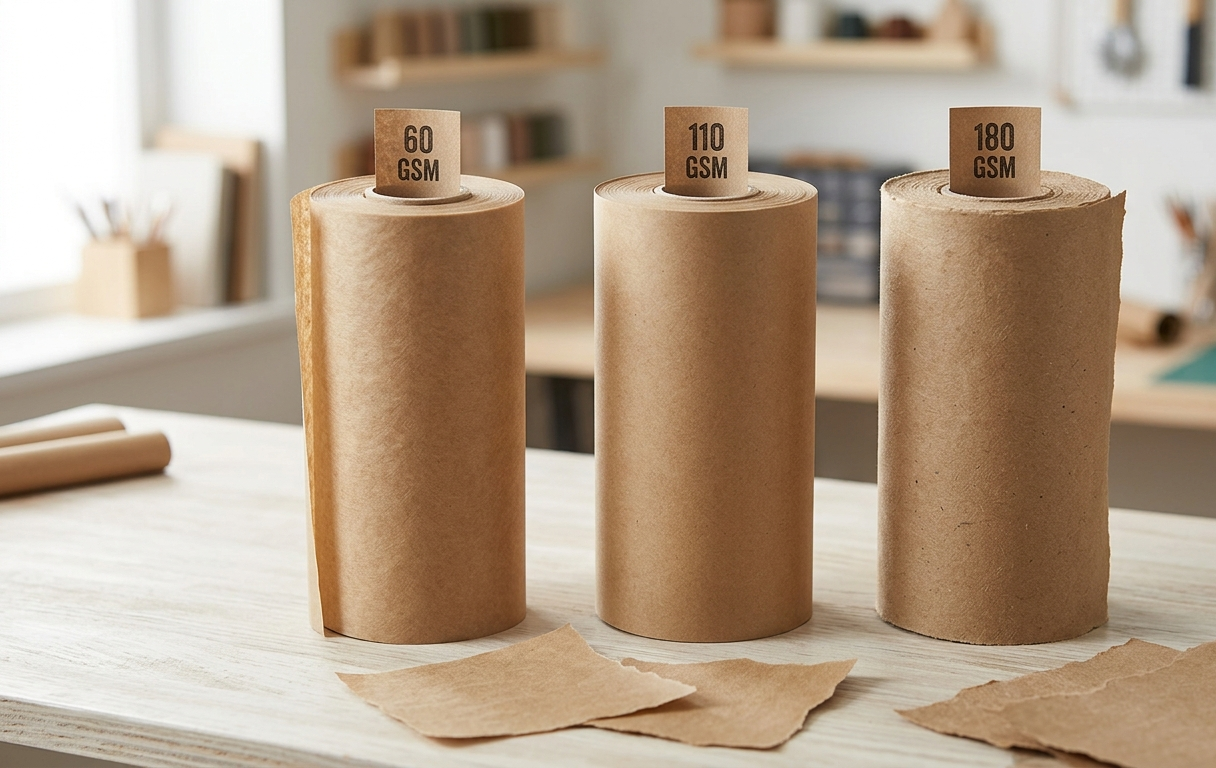
Pick any color, any fiber — weight still changes how the paper behaves in your hands. GSM, grams per square meter, is the number that matters. Light kraft crumples and interleaves. Heavy kraft protects and stiffens. Simple as that.
| Alcance do GSM | Character | Common uses |
| 30–50 | Leve, flexível | Interleaving, void fill, wrapping |
| 60–90 | All-purpose | Product wrapping, bags, general packaging |
| 100–120 | Sturdy | Heavy wrapping, fragile-item protection |
| 120–200+ | Rigid, board-like | Liners, industrial, backing |
Getting the weight right is the single biggest lever you’ve got on cost and performance. Go too light, it tears. Go too heavy, you overpay on every unit shipped. Our Tabela de gramatura (GSM) do papel kraft and the fuller kraft paper weight and GSM guide break the ranges down application by application.
Specialty and Coated Kraft Grades
Past the basics sit the specialty grades kraft engineered for one specific job:
- Sulfur-free kraft: a clean base with no free sulfur, essential anywhere the paper touches silver, electronics, or other tarnish-prone metals. See our sulfur-free paper overview.
- VCI kraft: loaded with corrosion inhibitors to guard metal parts in transit.
- Papel kraft com revestimento de polietileno: laminated for moisture and grease resistance, a staple in food and industrial packaging.
- Silicone-coated kraft: the release-liner grade that carries adhesives.
- Glassine and greaseproof kraft: densified for smoothness and grease resistance.
Choosing a specialty grade is really about the environment the paper has to live in. Metal parts want sulfur-free or VCI. Adhesives want silicone-coated. Moisture calls for poly-coated. Grab a plain grade for a specialty job and the failure hides — tarnish, rust, a slow leak — surfacing only after the product’s already shipped and it’s your problem to explain. That’s one of the most expensive mistakes in packaging, precisely because it’s invisible until it’s not.
How to Choose the Right Type: A Decision Path
When a buyer isn’t sure which kraft to order, we walk the same short path every time:
- What does it protect or wrap? Fragile, heavy, metal, food, or general goods — this flags any specialty need.
- How much strength does it need? Heavier GSM and virgin fiber for demanding loads; lighter recycled for everyday wrapping.
- Does appearance matter? White and printed for retail-facing; brown for behind-the-scenes.
- Any contact sensitivity? Metal, food, or adhesive contact forces a specialty grade — sulfur-free, poly-coated, or silicone-coated.
- What’s the sustainability target? Recycled fiber and minimal coating where the environmental story counts.
Answer those five and, honestly, the grade nearly picks itself.
Kraft in Context
It helps to know where kraft stands next to its cousins, too. Kraft, newsprint, and recycled packing paper each own a niche — we mapped all three in newsprint vs. kraft vs. recycled packing paper. And glassine, which is technically a densified member of the kraft family, gets mistaken for standard kraft constantly. We sorted that confusion out in glassine paper vs. kraft paper.
Storing Kraft So It Performs When You Need It
Kraft is tough. It’s not, however, indifferent to how you treat it in storage. Paper is hygroscopic — it drinks moisture out of humid air and gives it back when things dry out — and both directions cause grief. A roll that’s soaked up humidity goes soft, cockles at the edges, and jams a dispenser or wrinkles mid-wrap. A roll left bone-dry turns brittle and cracks at the fold. The fix costs nothing. Keep rolls up off concrete floors, which wick moisture straight upward. Store them somewhere with a stable indoor climate, not the drafty corner of an unheated warehouse. And leave the outer wrap on until the roll actually goes into service. For the specialty grades the stakes climb higher — sulfur-free and VCI kraft especially should stay sealed until use, because open air degrades the exact property you paid extra to get. A little storage discipline protects the strength and cleanliness you carefully specified in the first place.
So remember this and the rest falls into place: “kraft paper” is a family, not a single product. Once you think in color, fiber, weight, and specialty function, picking the right grade turns into a quick, confident call instead of a shot in the dark.
Perguntas frequentes
What are the main types of kraft paper?
Kraft splits along a few axes at once: color (natural brown versus bleached white), fiber source (virgin versus recycled), weight (light interleaving grades all the way up to heavy board-like liners), and specialty function (sulfur-free, VCI, poly-coated, silicone-coated, glassine). Real buying decisions combine them — say, a heavy virgin brown kraft for industrial shipping, or a light bleached white for retail wrapping. The trick is holding all four axes in your head at the same time, because that’s how you land on the one grade that actually fits the job instead of a near-miss.
Which kraft paper is the strongest?
Natural brown virgin kraft, and it comes down to fiber integrity. Skip the bleaching step and you preserve the long, undamaged fibers the kraft process produces; use virgin pulp and those fibers haven’t been shortened by a trip through recycling. Stack a heavier GSM on top of that and you’ve got the maximum tear and burst resistance kraft can offer. So if your application involves sharp edges, real weight, or genuinely rough handling, that’s the grade to spec — anything lighter or recycled is a compromise you’ll feel.
Is recycled kraft paper weaker than virgin kraft?
Slightly weaker, but rarely by enough to matter. Recycled fibers have already been through papermaking once, so they’re shorter and interlock a touch less tightly, which trims tear strength a little. For everyday wrapping, void fill, and general packaging, recycled performs perfectly well and carries a stronger sustainability story at a lower price. Save virgin kraft for the genuinely demanding jobs — the heavy, the sharp, the high-purity applications where every last bit of fiber strength actually earns its keep.
When do I need a specialty kraft grade instead of standard kraft?
Whenever the paper’s environment or its contact surface creates a risk that plain kraft simply can’t handle. Rust-prone metal parts need VCI kraft. Silver, electronics, and tarnish-sensitive metals need sulfur-free. Moisture or grease exposure calls for poly-coated. Adhesive products need silicone-coated. The danger with using standard kraft here is that it fails quietly — the tarnish, rust, or leak only turns up after the product ships — so matching the specialty grade to the hazard up front is almost always worth the small premium.
What GSM should I choose for kraft paper?
It tracks the job: 30–50 GSM for light interleaving and void fill, 60–90 for general wrapping and bags, 100–120 for heavier or fragile-item protection, and 120-plus for rigid liners and industrial backing. Weight is the biggest single lever on both cost and performance, so fight the urge to buy one heavy grade for the whole operation “just in case.” Match the GSM to each application and you sidestep both the tearing failures and the slow bleed of overspending on stiffness nobody needed.
*Not sure which grade fits your product? Compare weights in our kraft paper GSM chart, or talk to our team about specialty grades like sulfur-free paper.*
About the Author
Ashley Zack — Technical Content Lead, Kangchuang Papers
Ashley Zack has spent over a decade around industrial and specialty paper from mill-floor production to advising packaging engineers and procurement teams on grade selection. At Kangchuang Papers, they translate hands-on manufacturing experience into practical, jargon-free guidance for buyers sourcing kraft, release, newsprint, and anti-corrosion papers. When a spec sheet and a real-world packing line disagree, they’ve usually seen why firsthand.
Have a sourcing question or a grade you can’t pin down? Get in touch with the Kangchuang Papers team.