Skip to content
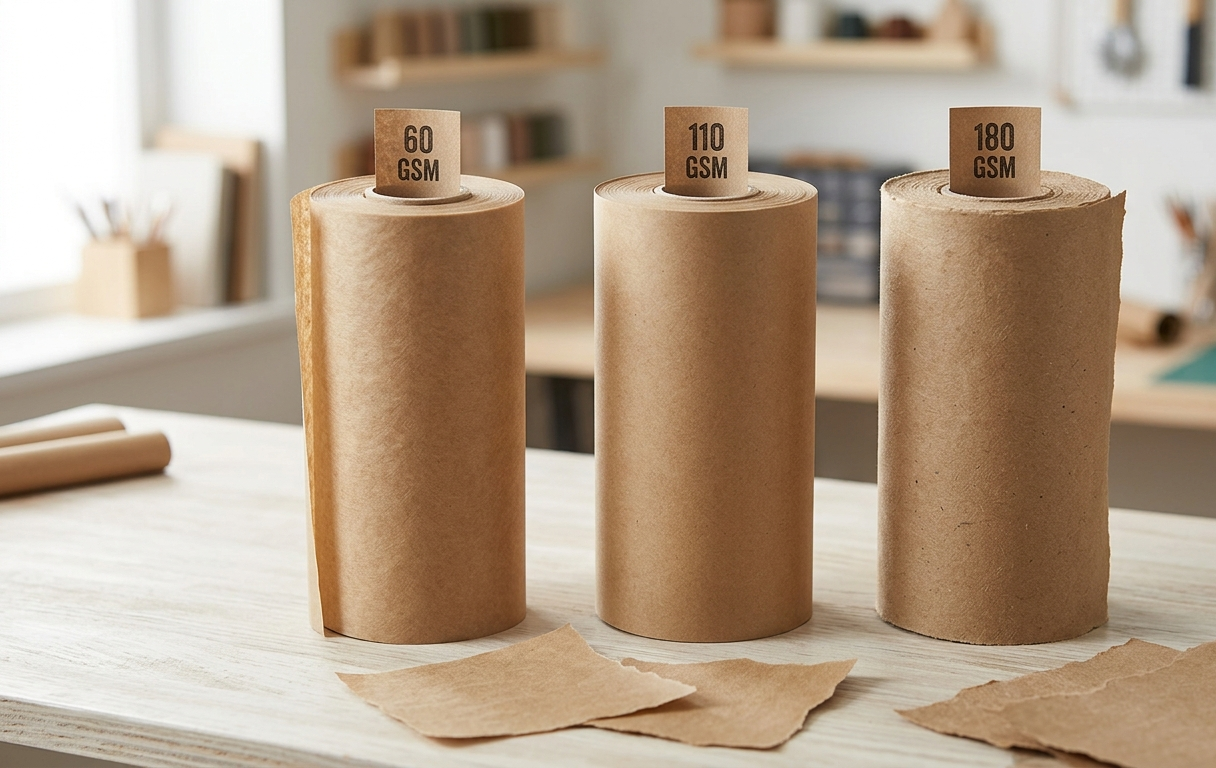
Pick the wrong kraft paper weight and the problem shows up at the worst time. A sheet that is too light tears during shipping and your product arrives damaged. A sheet that is too heavy wrinkles, refuses to fold, and costs more than the job needs. GSM is the number that tells you, before you ever touch the roll, whether the paper will hold up.
As a kraft paper manufacturer, we get the GSM question on almost every quote. This guide explains what GSM means, how it relates to thickness and US pound weights, and which weight to choose for the most common jobs.
What GSM Actually Measures
GSM stands for grams per square meter. It is the weight of one square meter of the paper. Higher GSM means a heavier, and usually thicker and stronger, sheet.
The reason GSM is the cleaner system is that it applies the same way to every paper grade. One square meter, weighed in grams, every time. That makes it easy to compare a 70 GSM kraft to a 70 GSM liner without worrying about sheet-size quirks.
One caution. GSM correlates strongly with thickness, but it is not the same as thickness. Two kraft papers at the same GSM can measure slightly different in caliper because fiber density varies with the pulp and the mill. If thickness is critical for your job, ask for the caliper figure, not just the GSM.
GSM, Pounds, and Caliper
US buyers often see kraft quoted in pounds (#), which is basis weight — the weight of 500 sheets at a standard size. For packaging kraft, that standard is the 24 x 36 inch sheet.
Two practical conversions:
- Pounds to GSM (24 x 36 packaging basis): multiply the pound value by about 1.63. A 50# kraft is roughly 81 GSM.
- GSM to pounds: divide GSM by 1.63 to estimate pounds.
Watch the basis-size trap. A 50# packaging kraft and a 50# printing paper are not the same thickness, because printing grades use a different basis sheet size. Compare like with like — which is exactly why GSM is the safer language for international orders.
Caliper is thickness, measured in mils or points (thousandths of an inch). It is the spec that matters for fit, fold, and feed on automated equipment.
Kraft Paper GSM Chart
Use this as a starting point. Exact thickness varies by fiber and finish — confirm caliper for tight-tolerance work.
| GSM (approx.) | US Basis (approx.) | Feel | Common Uses |
| 40–60 GSM | ~25–37# | Light, flexible | Interleaving, void fill, wrapping, gusseted pouches |
| 60–80 GSM | ~37–50# | Balanced | General wrapping, bags, pouch laminates, packing paper |
| 80–120 GSM | ~50–74# | Firm | Sturdy bags, mailers, protective wrap |
| 120–160 GSM | ~74–98# | Stiff | Premium retail wrap, heavier packaging |
| 160–200+ GSM | ~98–123#+ | Rigid | Industrial parts, hardware, heavy-duty sheets |
Around 45 GSM is favored for gusseted and stand-up pouches because it stays flexible. The 60–70 GSM range is the everyday workhorse. Push past 80 GSM for pouch laminates and the bag can be hard to fill and open. For industrial and hardware packing, 160–200 GSM gives you the strength to take the abuse.
How to Choose the Right Weight
Skip the guesswork by answering four questions:
- How rough is the handling? Long courier journeys and heavy parts push you up in GSM. Gentle, short trips let you go lighter.
- Does it need to fold or conform? Pouches, wraps, and interleaving want lighter paper. Rigid protection wants heavier.
- Does it need to look premium? Heavier kraft reads as quality in retail; for pure protection, that weight may be wasted spend.
- What is the cost per unit target? The goal is the lightest weight that still passes your handling test.
GSM for Specialty Kraft Grades
VCI / rust-proof kraft typically runs lighter-to-mid range so it conforms to parts. See our rust-proof VCI paper range for matching weight to part size.
Release liner base paper runs roughly 35–160 GSM depending on the converting line. More in our release paper product page.
Partition and interleaving leans lighter so sheets stack cleanly. See our industrial paper range for these grades.
Frequently Asked Questions
What does GSM mean for kraft paper?
GSM is grams per square meter — the weight of one square meter of the paper. Higher GSM generally means a heavier, thicker, stronger sheet.
How do I convert kraft paper pounds to GSM?
For packaging kraft on the 24 x 36 basis, multiply the pound value by about 1.63. A 40# kraft is roughly 65 GSM.
Is higher GSM always better?
No. Higher GSM is stronger and stiffer but costs more and can be too rigid to fold or conform. Choose the lightest weight that still survives your handling conditions.
What GSM is best for packaging?
For general packing, 60–90 GSM covers most needs. For heavy or industrial parts, 160–200 GSM. For flexible pouches, around 45–70 GSM.
Does the same GSM always mean the same thickness?
Not exactly. GSM tracks thickness closely but fiber density varies, so two papers at the same GSM can differ slightly in caliper. Ask for the caliper figure when thickness is critical.