Skip to content
For most ecommerce shipping, 40 lb kraft paper is the standard choice because it balances cost and protection better than lighter stock. Use 30 lb kraft for pure void fill, 40 lb as the all-round default for wrapping and cushioning, and 60 lb or heavier for surface protection of heavy or fragile items. Kraft paper sells in basis weights from 30 lb to 70 lb (Oren International, 2024). The 40 lb grade is the industry standard for packing paper because it resists crushing better than 30 lb, so you use less of it per parcel (EcoEnclose, 2026). Weight and roll width affect cost more than buyers expect.
What does kraft paper “weight” actually mean?
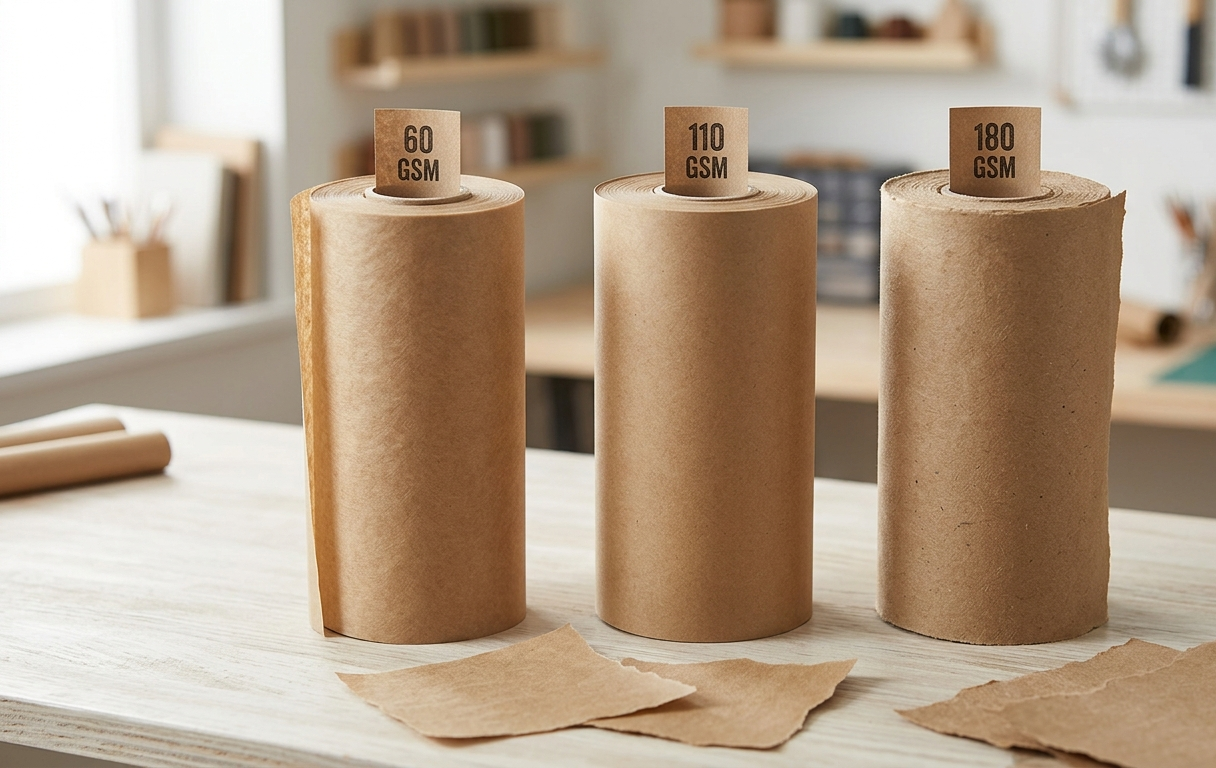
Kraft paper weight, written as a number followed by “lb” or “#”, is the basis weight: how much a standard ream of the paper weighs. A higher number means a heavier, thicker, more tear-resistant sheet. Outside the United States the same property is measured in grams per square meter (GSM), so a spec may list both (epackprinting, 2024).
Basis weight is the single most useful number on a kraft paper spec because it predicts strength and cost at the same time. Heavier paper resists tearing and crushing, which protects better, but it also costs more per square foot and adds dimensional weight to a parcel. The job of an ecommerce packer is to pick the lightest weight that still protects the product, since paper that is heavier than the job needs is money spent on the floor. For exact lb-to-GSM ranges, see our kraft paper GSM chart.
Which kraft paper weight is best for ecommerce shipping?
The 40 lb grade is the best all-round kraft paper weight for ecommerce shipping. It is the industry standard for packing paper because it holds up to crumpling without collapsing the way 30 lb does, so each wad of paper does more protective work and you use fewer feet per box (EcoEnclose, 2026).
That said, “best” depends on the job inside the box. A lightweight apparel order does not need the same paper as a ceramic mug. Most growing brands settle on two weights: a lighter grade for void fill and a heavier grade for wrapping and surface protection. Running two weights instead of one usually lowers total paper cost, because you stop using expensive heavy paper to fill empty space (The Boxery, 2023).
Kraft paper weight by use case (chart)
The table below maps common kraft paper weights to ecommerce packing jobs. Kraft paper is commonly stocked from 30 lb to 70 lb, and the right grade is set by how much protection the product needs (Oren International, 2024).
| Kraft weight | Best for | Why |
| 30 lb (light) | Void fill, light wrapping, interleaving | Crumples easily and cheaply to fill empty space; gives less crush resistance than 40 lb |
| 40 lb (standard) | All-round packing, cushioning, wrapping | Industry-standard balance of cost and protection; the default for most ecommerce |
| 50 lb to 60 lb (heavy) | Wrapping heavy or scratch-prone items, box liners | More surface protection and tear resistance for fragile or hard goods |
| 60 lb to 70 lb (extra heavy) | Rigid dividers, dunnage, heavy-duty wrapping | Maximum strength for the heaviest or most fragile shipments |
30 lb vs 40 lb vs 60 lb kraft paper: what’s the difference?
The practical difference is crush resistance and how many feet you use per parcel. 30 lb is the lightest common grade, ideal for void fill because it crumples cheaply, but it gives way under pressure faster than heavier stock. 40 lb resists crumpling enough to protect with less material, which is why it costs slightly more per roll yet often costs less per parcel (EcoEnclose, 2026).
60 lb steps up again. It is stiffer and more tear-resistant, which suits wrapping heavy or scratch-prone products and lining boxes, but it is overkill and overspend for filling empty corners. The takeaway: do not judge kraft paper by roll price alone. A 40 lb roll that protects with half the paper of a 30 lb roll is the cheaper choice in practice (The Boxery, 2023).
Does heavier kraft paper always protect better?
No. Heavier kraft paper resists tearing and crushing better, but matching weight to the job protects better than simply going heavier. Paper that is heavier than the product needs adds dimensional weight and cost without improving the unboxing or reducing damage (epackprinting, 2024).
Protection comes from the right weight used the right way, not from maximum thickness. A light grade crumpled correctly cushions a soft-goods order perfectly, while a heavy grade wrapped around a mug guards the surface from scratches. Using one heavy weight for everything wastes money on the easy items and can still under-protect the hard ones if it is not applied as cushioning. Two weights, matched to the contents, beats one heavy roll for both cost and damage rates.
How much kraft paper weight do you need for fragile items?
For fragile items, use a heavier wrapping grade of 50 lb to 60 lb around each piece and a lighter 30 lb to 40 lb grade as cushioning void fill in the surrounding space. Heavier weights provide the surface protection and tear resistance that breakables need, while lighter paper fills the gaps that stop movement in transit (Oren International, 2024).
The most common fragile-shipping mistake is relying on void fill alone. Void fill stops the product from sliding, but it does not protect a surface from impact or scratches on its own. Wrap first with a heavier grade, then fill the remaining space with a lighter grade so the item cannot shift. This two-layer approach uses paper efficiently and lowers breakage, which matters more than the headline price of either roll.
How to buy the right kraft paper for your packing line
Buy by weight and roll width matched to your dispenser, not by price per roll. Weight sets protection and cost per parcel, and width determines how much trimming and waste your packers generate. A roll that is too wide forces extra cutting; one too narrow forces double-wrapping. Both raise labor and material cost (The Boxery, 2023).
A short sourcing checklist:
- Pick two weights: a light grade (30 lb to 40 lb) for void fill and a heavier grade (50 lb to 60 lb) for wrapping.
- Match roll width to your boxes and dispenser to cut trim waste.
- Confirm food-contact approval if you ship anything edible, since not every kraft grade is food-safe (packagingsupplies.com).
- Check virgin vs recycled: recycled kraft costs less and suits void fill; virgin kraft is stronger for wrapping and printing (Oren International, 2024).
- Confirm minimums and custom widths with the supplier before committing.
Kangchuang Paper manufactures kraft and industrial packaging paper in custom widths and grades with free samples and fast turnaround. To benchmark your current packing paper or spec a new weight, request a quote or free sample.
FAQ
What is the standard kraft paper weight for shipping?
40 lb kraft paper is the standard for ecommerce shipping and packing. It resists crumpling better than 30 lb, so each piece does more protective work and you use fewer feet per box (EcoEnclose, 2026). Lighter 30 lb suits pure void fill, and heavier 50 lb to 60 lb suits wrapping fragile or heavy goods.
Is 30 lb or 40 lb kraft paper better for void fill?
For pure void fill, 30 lb is the more economical choice because it crumples easily to fill empty corners at a lower cost. The trade-off is that 30 lb gives less crush resistance than 40 lb, so for parcels that need cushioning as well as fill, many brands step up to 40 lb (EcoEnclose, 2026).
What kraft paper weight protects fragile items?
Wrap fragile items in a heavier 50 lb to 60 lb grade for surface and tear protection, then surround them with a lighter 30 lb to 40 lb grade as cushioning void fill (Oren International, 2024). The two-layer method protects better than void fill alone and uses paper efficiently.
Is kraft paper measured in lb or GSM?
Both. United States buyers usually see basis weight in pounds (30 lb, 40 lb, 60 lb), while GSM is the metric measure used elsewhere (epackprinting, 2024). The lb-to-GSM conversion depends on the ream size, so confirm both numbers on the spec. Our kraft paper GSM chart explains the ranges.
Is heavier kraft paper always stronger?
Heavier kraft paper is more tear-resistant and crush-resistant, but heavier is not always the better packing choice. Paper that is heavier than the product needs adds dimensional weight and cost without lowering damage (epackprinting, 2024). Match weight to the job rather than defaulting to the heaviest grade.
Is recycled kraft paper strong enough for ecommerce?
Recycled kraft is strong enough for void fill, dunnage, box liners, and interleaving, and it costs less than virgin kraft (Oren International, 2024). For wrapping heavy or scratch-prone items where tear resistance and print quality matter most, virgin kraft performs better. Many brands run recycled for fill and virgin for wrapping.