Skip to content
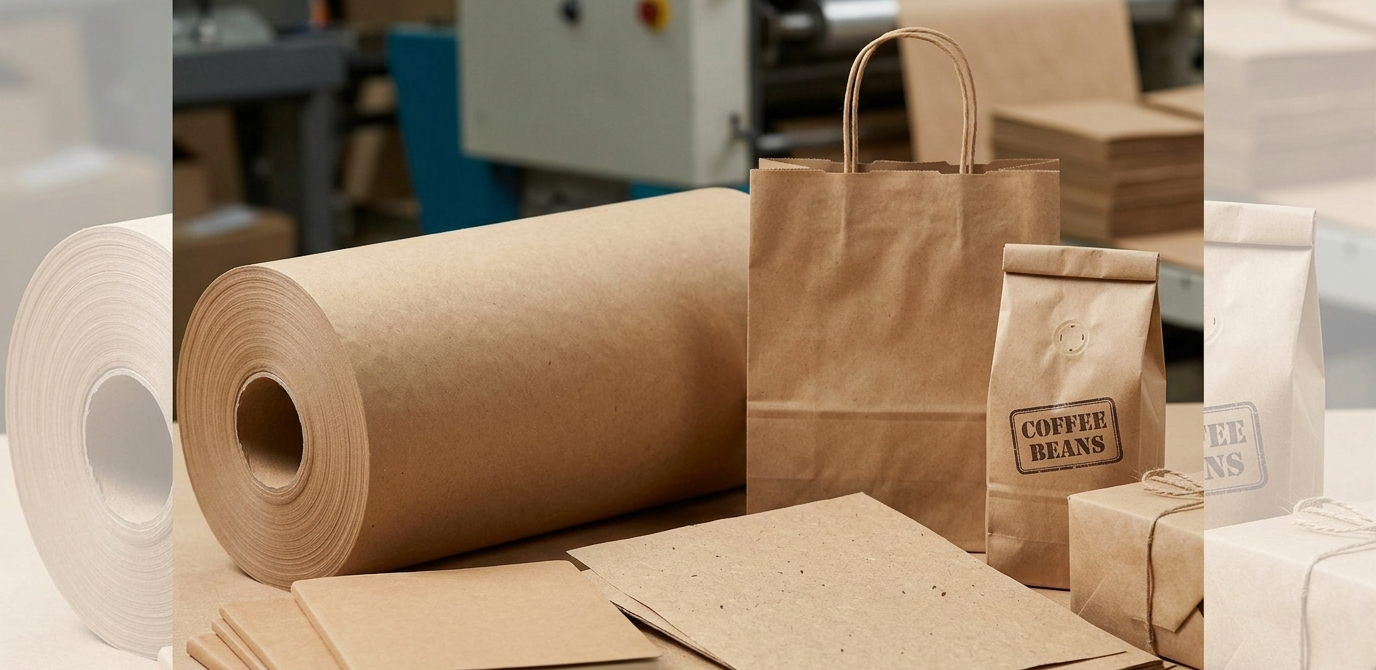
Kraft paper is a strong, durable paper produced through the kraft chemical pulping process, which preserves long wood fibers to maximize tensile and tear strength. The name comes from the German word kraft, meaning strength. It is used worldwide for industrial packaging, e-commerce shipping, food service wraps, sack production, and protective converting applications, with weights typically ranging from 30 GSM to 440 GSM.
Kraft Paper Quick Reference Chart
| Grade | Typical GSM | Color | Best For |
|---|---|---|---|
| Natural Kraft (Virgin) | 60–135 GSM | Brown | Industrial wrapping, sack paper, void fill, retail bags |
| Recycled Kraft | 70–140 GSM | Brown (slightly grey) | Sustainable e-commerce packaging, void fill |
| Bleached Kraft (White) | 40–120 GSM | White | Food contact, retail bags, branded packaging |
| MG Kraft (Machine Glazed) | 40–90 GSM | Brown or white | Food wraps, label backing, lamination base |
| Sack Kraft | 70–110 GSM | Brown | Cement bags, flour bags, multiwall sacks |
| Greaseproof Kraft | 30–60 GSM | Natural / white | Food packaging, deli wraps |
| Kraft Liner / Test Liner | 100–440 GSM | Brown | Corrugated box outer / inner liner |
| Kraft Fluting | 100–200 GSM | Brown | Corrugated middle layer (fluted) |
How Kraft Paper Is Made
The kraft pulping process — invented by Carl F. Dahl in 1879 — uses sodium hydroxide and sodium sulfide to break wood chips down into individual cellulose fibers. Unlike sulfite pulping, the kraft process keeps the long fibers largely intact, which is why kraft paper is dramatically stronger than newsprint or sulfite-pulped papers.
Production stages:
- Wood chip preparation: Softwood (pine, spruce) for strength, hardwood (birch, eucalyptus) blended for smoothness
- Digester / pulping: Chips cooked in white liquor (NaOH + Na₂S) under pressure to dissolve lignin
- Washing and screening: Lignin and chemicals washed out; fibers screened
- Optional bleaching: For white kraft, fibers go through ECF (Elemental Chlorine Free) or TCF (Totally Chlorine Free) bleaching
- Refining: Fibers are mechanically refined to control strength, porosity, and bulk
- Paper machine: Pulp slurry (~99% water) drained through forming wire, pressed, and dried into continuous web
- Calendering: Optional smoothing through heated rollers; MG kraft skips heavy calendering to retain texture
- Reel-up and conversion: Wound onto large parent rolls, then slit to customer widths or sheeted
Types of Kraft Paper Explained
Natural (Virgin) Kraft
Made from 100 percent virgin softwood fiber. Highest strength-to-weight ratio. Brown color from residual lignin. The default choice for sack paper, multiwall bags, and demanding industrial wrapping. Standard tensile strength runs 5–8 kN/m at 80 GSM.
Recycled Kraft
Made from recovered kraft fiber (corrugated trim, used boxes). Slightly weaker than virgin (typically 10–25 percent lower tensile) but significantly more sustainable. Color tends grey-brown rather than warm brown. Most e-commerce void fill and protective wrapping uses recycled kraft.
Bleached Kraft (White Kraft)
Virgin kraft that has been bleached. Slightly weaker than natural kraft due to bleaching, but visually clean and printable. Used for retail shopping bags, branded packaging, food-service items, and any application where appearance matters.
Machine Glazed (MG) Kraft
One side is glazed against a polished Yankee dryer cylinder, producing a smooth, semi-glossy surface; the other side is matte. Excellent printability on the glazed side. Common in food packaging, candy wrappers, and label backing.
Sack Kraft
Engineered specifically for multiwall paper sacks (cement, flour, animal feed, chemicals). Designed with high air permeability for fast filling, high tensile energy absorption to survive drop tests, and extensibility (often 4–8 percent stretch in machine direction).
Greaseproof Kraft
Calendered to extreme density so the fiber matrix resists oil and grease penetration without coatings. Used for butcher paper, deli wraps, baked goods, and quick-service food.
Kraft Liner and Kraft Fluting
The two main components of corrugated board. Kraft liner forms the outer and inner faces; fluting paper is corrugated and bonded between liners. Kraft liner uses virgin or recycled fiber depending on grade — virgin for premium boxes, test liner for general transit packaging.
Understanding GSM (Grams per Square Meter)
GSM measures the weight of one square meter of paper. It is the most universal way to specify paper. Conversion: GSM × 0.205 ≈ pounds per ream (US measure based on 25 in × 38 in / 500 sheet ream).
Typical GSM by application:
- 30–50 GSM: Tissue, food wraps, light interleaving
- 60–80 GSM: Light retail bags, void fill, sack outers
- 80–120 GSM: Standard industrial wrapping, retail shopping bags
- 120–200 GSM: Heavy-duty wrapping, drum liners, heavy multiwall sack
- 200–440 GSM: Kraft liner board for corrugated, heavy industrial protective
Key Properties That Define Kraft Paper Quality
- Tensile strength: Resistance to pulling apart in machine and cross direction (kN/m). Critical for sack paper and heavy wrapping.
- Burst strength: Pressure required to rupture the sheet (kPa). Important for shipping and sack applications.
- Tear strength: Resistance to tearing once started (mN). Often more critical than tensile in real-world use.
- Tensile Energy Absorption (TEA): Energy absorbed before failure. The headline number for sack kraft used in cement and chemicals.
- Porosity / air permeability: How fast air passes through. High porosity = fast filling for valve sacks; low porosity = better grease resistance.
- Stretch / extensibility: Especially important for sack paper, which must survive drop impacts.
- Smoothness: Affects print quality and converting performance.
- Grammage uniformity: Consistency in GSM across the web — controls converting waste.
Industrial Applications of Kraft Paper
E-commerce and Shipping Packaging
Recycled kraft at 50–70 GSM as void fill, kraft liner for boxes, kraft tape for sealing. Replacing plastic air pillows and bubble wrap with kraft has become a sustainability priority for major retailers since 2023.
Food Service and Food Contact
Bleached kraft for take-out bags, MG kraft for sandwich wraps, greaseproof for deli and bakery. FDA 21 CFR 176.170 compliance is mandatory for direct food contact.
Industrial Sacks (Multiwall)
Cement, flour, animal feed, chemicals, fertilizer. Sack kraft engineered for valve sack filling at 60+ bags per minute on automated lines.
Construction and Building
Insulation facing, drywall liner, asphalt-saturated kraft for roofing underlayment, vapor barrier paper.
Industrial Protection and Converting
The Slip sheets between metal coils, interleaving for sheet steel, masking paper for paint shops, void fill for heavy industrial parts during transit.
Retail and Branded Packaging
Premium shopping bags, gift wrap, takeaway boxes. Often printed with brand graphics on natural or bleached kraft.
Sustainability and Certifications
Kraft paper is fully recyclable, biodegradable, and compostable in industrial conditions. The kraft pulping process recycles its own chemicals — over 95 percent of the cooking liquor is recovered and reused, making kraft paper one of the most sustainable industrial materials on a lifecycle basis.
Certifications buyers should specify:
- FSC (Forest Stewardship Council): Verifies responsibly sourced fiber
- PEFC: Programme for the Endorsement of Forest Certification — alternative to FSC
- SFI: Sustainable Forestry Initiative (North American)
- FDA 21 CFR 176.170: Food contact compliance (US)
- EU Regulation 1935/2004: Food contact compliance (EU)
- ISO 14001: Environmental management systems for the mill
How to Specify Kraft Paper for Your Application
When ordering, give your supplier:
- Grade (natural, recycled, bleached, MG, sack, greaseproof)
- GSM (or US basis weight if your converting line is set up that way)
- Roll width and diameter, or sheet size
- Core size (typically 76 mm / 3 in)
- Tensile, burst, or TEA targets if your application is critical
- Required certifications (FSC, FDA, EU food contact)
- Volume and delivery cadence
Kangchuang Papers supplies natural kraft, recycled kraft, bleached kraft, sack kraft, and MG kraft to converters and packaging buyers across the United States, Canada, and Mexico, with custom GSM ranges and FSC-certified options available.
Frequently Asked Questions
What is kraft paper used for?
Kraft paper is used for industrial packaging, e-commerce shipping (void fill and outer wrap), food service (bags, wraps, greaseproof), multiwall sacks (cement, flour, feed), corrugated boxes (liner and fluting), and retail shopping bags.
What is the difference between kraft paper and regular paper?
Kraft paper uses the kraft chemical pulping process, which preserves long wood fibers and produces dramatically higher strength. Regular printing paper is typically lighter, smoother, and weaker because it uses different pulping and refining processes.
What does GSM mean for kraft paper?
GSM stands for grams per square meter — the weight of one square meter of paper. Higher GSM = thicker, stronger paper. Kraft paper typically ranges from 30 GSM (light wraps) to 440 GSM (heavy kraft liner).
Is kraft paper recyclable and biodegradable?
Yes. Kraft paper is fully recyclable in standard paper recycling streams, biodegradable, and compostable in industrial composting conditions. It is one of the most sustainable industrial packaging materials.
What is the difference between virgin and recycled kraft paper?
Virgin kraft is made from new wood fiber and has higher tensile and tear strength. Recycled kraft uses recovered fiber and is slightly weaker (10–25%) but more sustainable. Choose virgin for high-strength sacks and recycled for general-purpose wrapping and void fill.
Is kraft paper safe for food contact?
Bleached kraft, MG kraft, and greaseproof kraft can be food-safe when produced to FDA 21 CFR 176.170 (US) or EU 1935/2004 standards. Always confirm with the supplier whether the specific grade carries food-contact certification.
Conclusion
Kraft paper is the workhorse of industrial packaging. Its strength, recyclability, and versatility make it the default replacement as plastic packaging gets phased out across e-commerce, food service, and retail. Choosing the right grade, GSM, and certification matters as much as choosing the right supplier.
Kangchuang Papers supplies natural, recycled, bleached, and specialty kraft paper to converters and packaging buyers across North America. Contact our team for FSC-certified custom GSM rolls or sheets matched to your converting line.