Skip to content

Three of the most common industrial papers — newsprint, kraft paper, and recycled packing paper — get used interchangeably in shipping, void fill, wrapping, and packaging. They look similar on the roll, they cost similar amounts per ton, and they all show up in the same warehouses. But they are made differently, perform differently, and cost different amounts when you account for usage rate and damage rate. Picking the wrong one can mean broken product, oversized shipments, or paper costs that quietly inflate over a quarter.
This guide compares all three head-to-head, explains where each one earns its place, and shows what to demand from a supplier before signing a supply contract.
How Each Paper Is Made
Newsprint
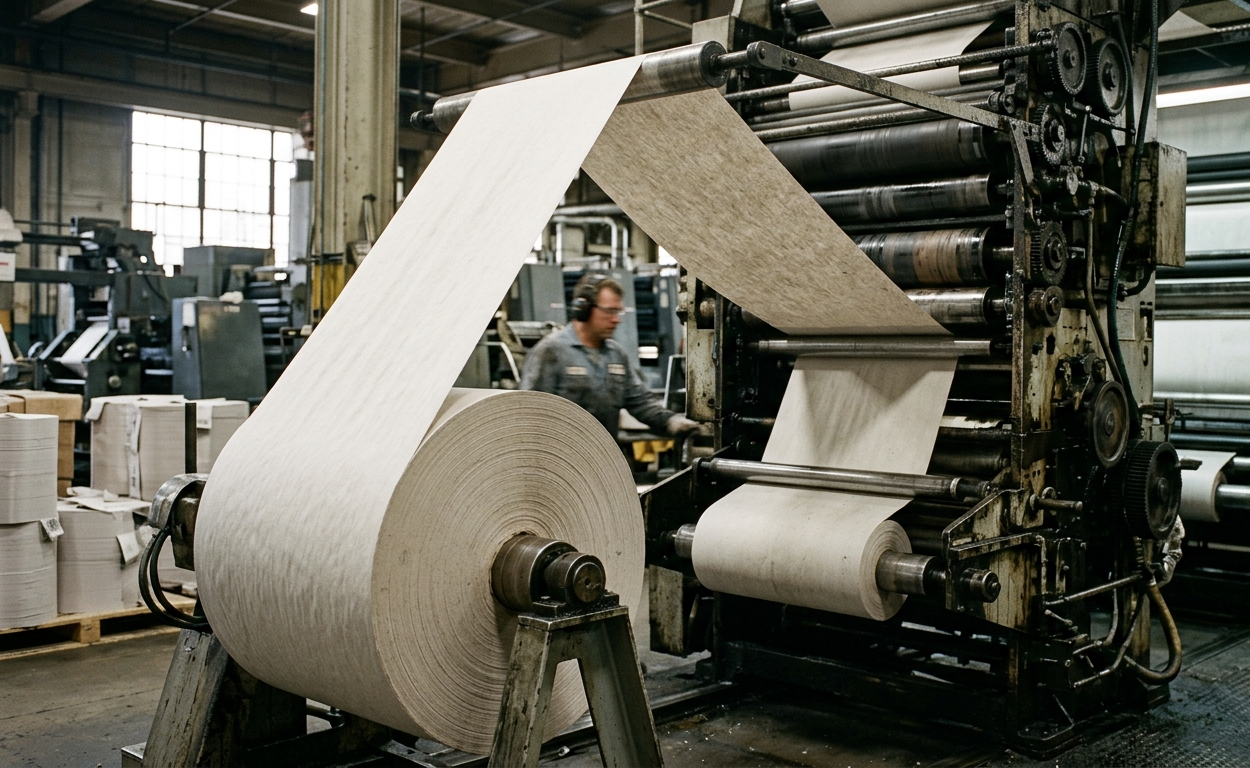
Newsprint is a lightweight, low-cost paper produced primarily from mechanical wood pulp — meaning the wood is ground into fiber rather than chemically broken down. Mechanical pulping retains most of the wood’s lignin, which is why newsprint yellows over time and has the distinctive dull off-white appearance. Basis weight is typically 40 to 49 grams per square meter, sometimes lighter.
The paper is engineered for one job historically: high-speed printing for newspapers. Tensile strength is high enough for the press, opacity is just adequate for double-sided print, and cost is the lowest among industrial papers. As newspaper consumption has fallen, mills have repurposed newsprint for industrial uses where its cheapness and softness are advantages.
Kraft Paper
Kraft paper is produced through the kraft chemical pulping process, which uses sodium hydroxide and sodium sulfide to dissolve lignin and isolate long, intact cellulose fibers. The result is a paper with dramatically higher strength than mechanical pulp paper — kraft fibers are longer, stronger, and bond better to each other. The standard color is the natural unbleached brown, though bleached white kraft is also common.
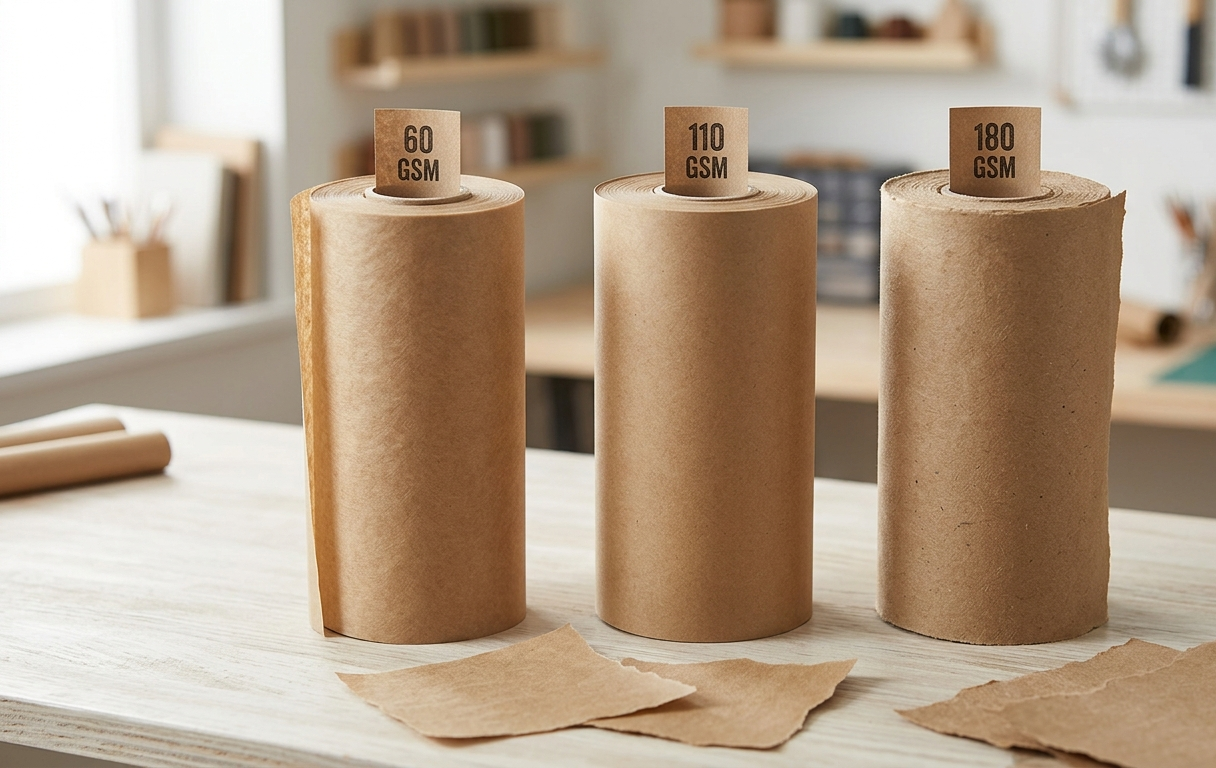
Kraft paper is the workhorse of industrial packaging. Basis weight typically ranges from 40 to 120 grams per square meter for wrapping and packing grades, with heavier grades available for sack and corrugated medium uses. The strength advantage is real and measurable: a 60 gsm kraft paper can match or exceed the tear and burst strength of an 80 gsm newsprint.
Recycled Packing Paper
Recycled packing paper is made from post-consumer or post-industrial waste paper that has been re-pulped, screened, and re-formed into new sheets. The pulp source can be anything from old corrugated containers to mixed office paper. Recycled paper fibers are shorter than virgin kraft fibers because every pulping cycle breaks them down further, so recycled paper is typically less strong than virgin kraft at the same basis weight.
Quality varies widely. Premium recycled packing paper made from clean post-industrial waste (factory trim, unprinted offcuts) can approach virgin kraft performance. Lower grades made from mixed post-consumer waste have visible fiber inclusions, lower strength, and less consistent thickness. Basis weight typically runs 40 to 90 grams per square meter.
Side-by-Side Comparison
| Attribute | Newsprint | Kraft Paper | Recycled Packing Paper |
| Pulp source | Mechanical wood pulp | Chemical kraft pulping (virgin) | Post-consumer or post-industrial waste |
| Typical basis weight | 40–49 gsm | 40–120 gsm | 40–90 gsm |
| Fiber length | Short | Long | Variable, generally short |
| Tensile strength | Low to moderate | High | Low to moderate |
| Tear resistance | Low | High | Low to moderate |
| Color | Off-white, yellows over time | Natural brown or bleached white | Brown to gray, variable |
| Cost per ton | Lowest | Moderate to high | Low to moderate |
| Best for void fill | Yes — soft, easy to crumple | Overkill | Yes |
| Best for heavy wrapping | No | Yes | Sometimes |
| Sustainability story | Mechanical, often recyclable | Strong if from FSC sources | Strongest — closes the loop |
| Print compatibility | Excellent for newsprint inks | Acceptable | Variable |
When Newsprint Is the Right Choice
Newsprint is the right choice when softness, low cost, and ease of crumpling matter more than tensile strength. Its short fibers and low basis weight make it ideal for filling space and absorbing minor impact without adding weight or cost.
Best fit applications:
- Void fill in shipping cartons — newsprint crumples easily and conforms to product shapes
- Wrapping fragile items where padding matters more than tear strength
- Garment cutting tables — single-use paper under fabric layers
- Stuffing for shoes, bags, and apparel during shipping
- Surface protection during light construction or painting
- Cushion layers in moving and household goods storage
Newsprint also has the lowest carbon and economic cost per cubic meter of fill volume, which makes it dominant in high-volume e-commerce and 3PL operations.
When Kraft Paper Is the Right Choice
Kraft paper is the right choice when the package needs to actually carry load, resist tearing, or stand up to abrasion in transit. Its long fibers give it a strength advantage that newsprint and recycled paper cannot match.
Best fit applications:
- Wrapping heavy items — machinery parts, hardware, tools
- Carrier bags, shopping bags, and grocery sacks where tear resistance is essential
- Wrapping rolls of metal, wire, or cable
- Industrial sack manufacturing for cement, flour, animal feed, and dry goods
- Edge protection and corner reinforcement on stacked goods
- Outer wrap on bulk products that will be banded or strapped
Kraft paper is also the standard substrate for further processing — it is the base for VCI paper, sulfur-free paper, partition paper for heavy applications, and for paper-based packaging laminations.
When Recycled Packing Paper Is the Right Choice
Recycled packing paper is the right choice when sustainability claims, cost, and adequate-but-not-extreme strength all matter. It is also a strong choice when your operation is committed to closed-loop materials.
Best fit applications:
- E-commerce void fill where the brand wants a sustainability story
- Wrapping and padding for products with moderate fragility
- Internal handling and transit between facilities
- Pallet topping and edge protection for non-critical loads
- Stuffing for retail packaging where appearance is secondary
- Industrial cushioning where the spec is functional, not premium
Recycled paper is also worth considering when your end customer specifically requires recycled content — many retail buyers and government procurement programs specify a minimum recycled fiber percentage in packaging materials.
The Strength Comparison That Matters Most
Tensile strength is the spec that decides whether a wrapping fails in transit. Tested in machine direction at the same basis weight, virgin kraft typically delivers around 4 to 5 kN/m. Recycled packing paper of equivalent weight delivers roughly 2.5 to 3.5 kN/m. Newsprint at typical 45 gsm delivers around 2 to 2.5 kN/m. The ratios shift with basis weight and grade quality, but the order is consistent: kraft is strongest, recycled is in the middle, newsprint is the lightest.
This is why a wrapping job that calls for kraft cannot be substituted with newsprint at the same basis weight. To match kraft strength with newsprint, you would need roughly double the basis weight — at which point the cost advantage disappears and the package becomes heavier and bulkier.
The Cost Calculation Buyers Often Get Wrong
Newsprint is cheapest per ton. That is the headline number, and it is what gets quoted when buyers compare suppliers. The number that matters more is cost per finished package or cost per damage-free shipment.
Consider void fill. A pallet of newsprint at $X per ton fills a given carton volume with a certain number of crumpled sheets. The same job done with recycled packing paper might require 15 percent fewer sheets because the paper is denser and more substantial. The same job done with kraft might require 30 percent fewer sheets but costs 50 percent more per ton.
The right answer depends on the application. For pure void fill in lightweight e-commerce, newsprint usually wins on total cost. For wrapping items that need strength, kraft wins because newsprint requires more layers and still risks failure. For brand-driven sustainability packaging, recycled often wins because the marketing benefit offsets the small cost premium.
Sustainability and Recyclability
All three papers are recyclable in standard streams, but the sustainability story differs. Newsprint and recycled packing paper carry an immediate environmental advantage because they use fewer virgin fibers per ton. Virgin kraft has the highest fiber strength but also the highest carbon and water footprint per ton produced.
Most professional buyers now apply a layered approach:
- Use recycled packing paper as the default for general void fill and protection
- Use kraft only where strength is genuinely required
- Use newsprint where its softness and cost advantage are decisive
- Specify FSC, SFI, or PEFC certification on virgin grades
- Specify minimum recycled content (often 60–100 percent) on recycled grades
How to Specify Each Paper Correctly
Before placing any volume order, demand:
- Basis weight (gsm) with stated tolerance — typically ±3 percent
- Roll dimensions — width, diameter, core size, length
- Tensile strength (machine and cross direction) in kN/m
- Tear resistance — Elmendorf method, in mN
- Burst strength for sack and bag applications
- Moisture content — typically 5–8 percent for industrial papers
- Recycled content percentage if applicable
- Sustainability certification (FSC, SFI, PEFC) if relevant
- A free sample roll for a real-condition test before committing to bulk
Common Mistakes Buyers Make
Choosing Newsprint for Heavy Wrapping
Newsprint at 45 gsm cannot reliably wrap heavy machined parts, even with multiple layers. The paper tears at handling stress points, exposes the product, and fails the protection test. Kraft is the right tool here, even at the higher cost per ton.
Choosing Premium Kraft for Pure Void Fill
If the only job is filling space inside a carton, kraft is overkill. Recycled packing paper or newsprint does the same job at lower cost and lower environmental impact. Kraft’s strength is wasted as void fill.
Assuming All Recycled Paper Is the Same
Recycled paper quality varies enormously. Premium recycled packing paper can approach virgin kraft strength. Low-grade recycled paper has visible inclusions and inconsistent thickness. Always test a roll from a new supplier before committing to volume.
Frequently Asked Questions
Can I use newsprint to wrap food?
Standard newsprint is not food-safe — printing inks and binders are not approved for food contact. Food-grade newsprint is available specifically for produce wrapping, fish counter use, and similar applications, and it carries food contact certification. Always verify before using.
What is the difference between kraft paper and craft paper?
Kraft is the correct industry term, derived from the German word for strength (kraft). The kraft pulping process produces strong paper. “Craft paper” is a common consumer misspelling that refers to the same product. The two are not different materials.
Is recycled packing paper as strong as virgin kraft?
Generally no. The repulping process shortens fibers, and the strength penalty is typically 20 to 40 percent at equivalent basis weight. Premium recycled grades close this gap but rarely match virgin kraft outright.
Why does newsprint yellow over time but kraft does not?
Newsprint contains residual lignin from mechanical pulping. Lignin reacts with light and air to produce yellow-brown chromophores. Kraft pulping removes most of the lignin, so kraft paper holds its color for years. Bleached kraft holds its color even longer.
Which paper is best for protecting silver-plated parts?
None of these three is the right choice without modification. Silver-plated parts need sulfur-free paper to prevent tarnish. Standard newsprint, kraft, and most recycled paper contain enough residual sulfur compounds to cause discoloration on sensitive plating. Use sulfur-free interleaving paper for those applications.
The Bottom Line
Newsprint is light, soft, and cheap — perfect for void fill and cushioning. Kraft paper is strong, durable, and engineered for load-bearing wrap and packaging. Recycled packing paper sits between the two on most performance dimensions and wins on sustainability. Choose by the strength your application actually requires, not by the cost-per-ton headline. Specify the paper, demand the test data, run a real-condition trial, and your packaging will perform consistently across thousands of shipments instead of failing unpredictably across hundreds.