Skip to content
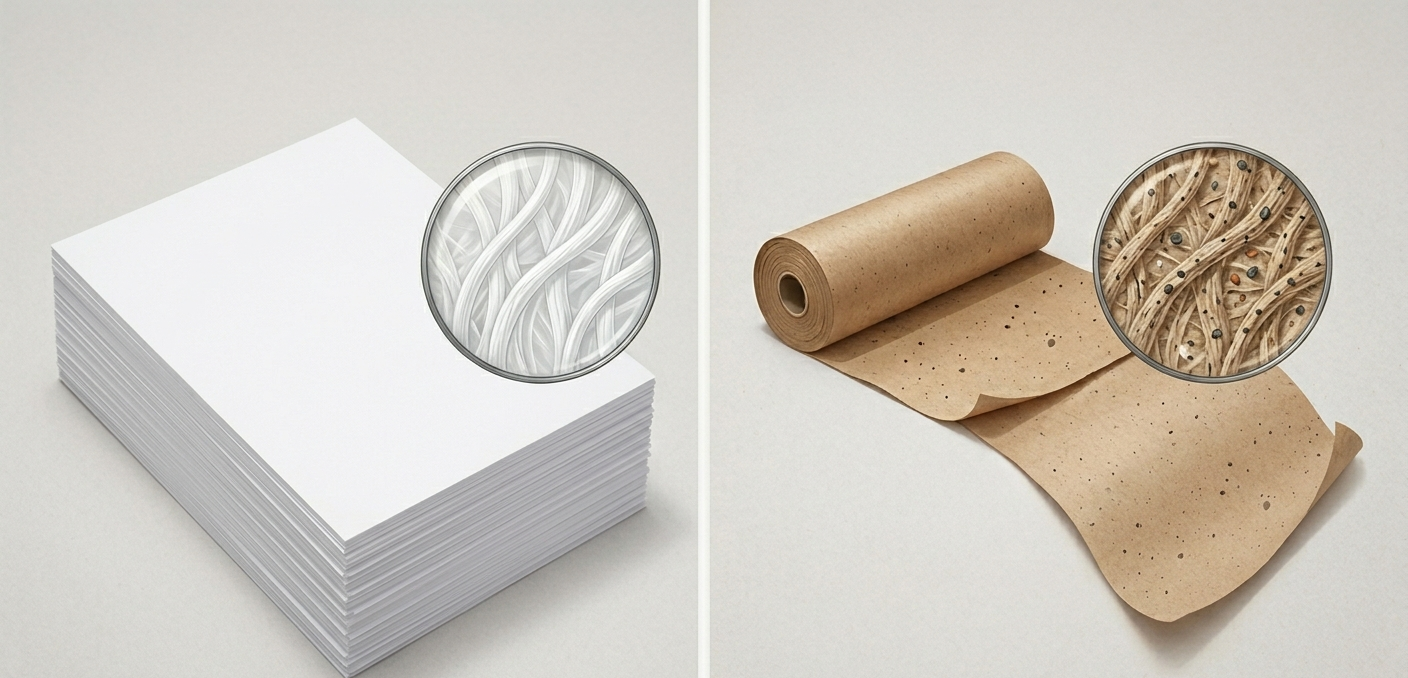
If you work with PCB components, silver-plated contacts, LED brackets, or optical glass, you already know that packaging choices are not cosmetic. The wrong paper next to a plated surface can tarnish it in days. Regular kraft paper is one of the biggest offenders because it carries trace sulfur compounds that attack silver, copper, and certain alloys.
Sulfur-free paper solves that specific problem. This piece explains what sulfur-free paper is, why it differs from regular kraft, and when each one is right for the job.
Why Regular Kraft Paper Fails for Electronics
Standard kraft paper is made from wood pulp using the kraft chemical pulping process. That process uses sodium sulfide and other sulfur compounds to break down lignin in the wood. Most of those sulfur compounds get washed out during production, but not all of them. Trace sulfur stays in the paper, sometimes at levels of 100 to 500 parts per million or higher.
For most uses, that trace sulfur is completely harmless. You can wrap furniture, books, or packaged food in regular kraft without any issue. But put regular kraft next to a silver-plated contact, a copper PCB trace, or a freshly manufactured LED bracket, and the story changes.
Sulfur vapor slowly reacts with silver to form silver sulfide. That is the black tarnish you see on old silverware. On PCB traces and LED contacts, even a very thin sulfide layer can fail electrical tests. Factories that ship electronics to Japan, Germany, and the US face immediate quality rejections for tarnished parts.
What Sulfur-Free Paper Is
Sulfur-free paper is manufactured with a controlled pulping and washing process that reduces sulfur content to under 50 parts per million, with premium grades under 20 ppm and specialty grades under 5 ppm. It is usually also acid-free and pH neutral, which further reduces the risk of chemical attack on sensitive surfaces.
At Kangchuang Paper, our sulfur-free paper is tested per roll and shipped with a test report that shows the measured sulfur content, pH, and chloride content. Our standard product runs at 20 ppm or lower. For silver plating applications we have grades at 5 ppm.
Sulfur-free paper can be made on kraft, tissue, or glassine substrates, and it comes in rolls, sheets, and custom widths.
Real-World Failure Cases
A common failure pattern: a factory wraps newly plated silver contacts in standard kraft paper for transit. Two weeks later the contacts arrive at the customer with a dull black film. Quality fails. Lot rejected. The factory eats the cost, re-plates the contacts, and ships again.
Another pattern: LED brackets stored on a warehouse shelf in untreated packaging. After a month the bright silver finish has turned brown around the edges. Assembly yields drop. Customer complaints spike.
Both failures are sulfur-driven, and both are preventable with a change of packaging paper. A single sulfur-free separator sheet between stacked brackets is often enough.
Cost Difference
Sulfur-free paper costs more than regular kraft. Not because of exotic materials, but because of tighter process control and the required per-lot testing. The premium at wholesale runs about 20 to 50 percent over standard kraft of the same gsm.
For a factory shipping thousands of PCBs or LED packages per week, that premium is nothing compared to a single tarnish rejection. One rejected lot can be worth more than a full year of sulfur-free paper supply.
When Regular Kraft Is Still Fine
Do not overthink this. If your product is not sulfur-sensitive, regular kraft works and costs less. Use regular kraft for general packaging, void fill, furniture wrap, paper bags, shipping protection, and most industrial applications where metal surfaces are not exposed or not sensitive to tarnish.
Sulfur-free paper is not a general-purpose replacement. It is a specialty product for a specific problem.
When Sulfur-Free Is Required
The Silver-plated electrical contacts and connectors. Copper-clad PCB boards. LED brackets and SMD packaging. Tin-plated terminals. Optical glass and mirrors with silvered coatings. Gold-plated medical devices and high-frequency connectors. Any product where surface tarnish would fail a quality test.
In these cases sulfur-free paper is not a nice-to-have. It is the default. A serious electronics manufacturer will have a written packaging specification that calls out sulfur content, and that specification gets enforced at incoming inspection.
What to Ask a Supplier
When you buy sulfur-free paper, ask for three things. First, the tested sulfur content in parts per million. Anyone can say sulfur-free, but the number on the test report is what matters. Second, the test method used, because results vary depending on the extraction procedure. Third, whether the paper is also acid-free or pH neutral, which matters when multiple chemical pathways could damage the surface.
At Kangchuang we provide a third-party test report with every production lot, or an in-house test with supporting documentation on request. We also support RoHS-compliant and halogen-free specifications for customers exporting to the EU and Japan.
The Bottom Line
Sulfur-free paper and regular kraft look the same, feel the same, and weigh the same. The difference is invisible until it costs you a shipment. For electronics, plated hardware, and sensitive optical surfaces, sulfur-free paper is cheap insurance against a very expensive problem.
For everything else, regular kraft does the job at a lower price. Match the paper to the product.