Skip to content
Three terms. Same general purpose. Wildly different products. Partition paper, interleaving paper, and slip sheets all exist to protect stacked products from contact damage during handling, storage, and transport. But they work at different scales, target different damage types, and cost very different amounts. Specifying the wrong one can mean shattered glass, scratched stainless, contaminated PCBs, or pallets that fall apart on a forklift.
This guide explains the role each one actually plays, how they overlap, when each is the correct choice, and what to look for in a supplier specification.
Defining Each Term Precisely
Partition Paper: Per-Unit Separation Inside a Container
Partition paper is paper inserted between individual product units within a single shipping container, box, or stacked group. The classic example is the cardboard or paper dividers in a wine box that keep the bottles from clinking together. In industrial use, partition paper separates each PCB in a stack, each sheet of glass on a rack, each photovoltaic cell in a tray. The defining feature is that partition paper handles unit-to-unit contact at small scale.
Interleaving Paper: Sheet-Between-Sheet Protection
Interleaving paper sits between flat sheets or panels that are stacked together. It is functionally similar to partition paper, but the term emphasizes paper-thin separation of large flat surfaces — think glass panels stacked for shipment, sheets of polished stainless steel, photovoltaic glass, copper sheets, or aluminum coil. The paper prevents abrasion as the sheets shift slightly under their own weight or during transit.
In practice, partition and interleaving overlap heavily. Some industries use the terms interchangeably; others draw a hard line between them. The most useful distinction is this: interleaving paper goes between similar large flat items that share a stack; partition paper goes between dissimilar smaller items that share a container.
Slip Sheet: Pallet-Scale Material Handling
A slip sheet is something different in scale and purpose. It is a thin, rigid sheet — usually fiberboard, kraft paperboard, or laminated paper — placed under a unit load instead of a wood pallet. It allows the load to be moved with a push-pull forklift attachment rather than standard pallet forks. Slip sheets save freight cost (one slip sheet weighs a fraction of a wood pallet), reduce export cost (no fumigation required), and pack more product per container.
Slip sheets are not protective interleaving. They are a load-handling alternative. The confusion arises because the words sound similar and because some shipping operations call any sheet placed in a stack a slip sheet.
Side-by-Side Comparison
| Attribute | Partition Paper | Interleaving Paper | Slip Sheet |
| Position | Between units inside a container | Between flat sheets in a stack | Beneath an entire unit load |
| Primary purpose | Prevent unit-to-unit contact | Prevent surface abrasion on flat sheets | Replace wood pallet for push-pull handling |
| Typical scale | Small to medium | Sheet to panel size | Pallet size (1–1.2 m wide) |
| Typical thickness | 0.05–0.3 mm | 0.05–0.5 mm | 0.6–3 mm |
| Material base | Sulfur-free, kraft, or specialty | Kraft, sulfur-free, or coated | Fiberboard or laminated kraft |
| Industries | Electronics, glass, photovoltaic, beverage | Glass manufacturing, metals, photovoltaic | Logistics, food, beverage, retail distribution |
| Reusable | Sometimes | Sometimes | Often (high-grade slip sheets) |
| Replaces wood pallet | No | No | Yes — its core purpose |
When Partition Paper Is the Right Choice
Partition paper is essential whenever individual product units travel together and would contact each other in motion. The risk is not always visible damage; in electronics and semiconductors, the bigger risk is invisible surface contamination from contact between coatings, fingerprints, or sulfide tarnish.
Common applications:
- PCB stacking during transit between production stages — sulfur-free partition paper prevents silver tarnish and physical scratching
- LED component trays — partition paper between layers preserves reflective surfaces
- Photovoltaic cell stacking — separator paper protects fragile cells from edge chipping and surface contamination
- Glass bottles, jars, and lab glassware — partition paper or paper-board dividers absorb impact
- Stamped metal parts in shipping totes — partition paper prevents cosmetic surface marring
When Interleaving Paper Is the Right Choice
Interleaving paper is the standard between flat sheets in a vertical or horizontal stack. The defining requirement is sheet-scale: the paper must be wide and long enough to fully cover the surface, with consistent flatness so it does not introduce its own pressure points.
Common applications:
- Float glass and architectural glass — interleaving paper prevents fogging and surface haze during long-term storage
- Photovoltaic cover glass shipped in standing racks
- Polished stainless steel and aluminum sheets — interleaving prevents micro-scratches that show under finishing
- Copper sheets and rolled goods — sulfur-free interleaving paper prevents tarnish
- Specialty plastic films stored in stacks before lamination
When a Slip Sheet Is the Right Choice
A slip sheet is the right choice when you are trying to solve a logistics problem, not a damage problem. The decision is about pallet replacement, freight efficiency, and material handling equipment — not about protecting product surfaces.
Common applications:
- High-volume export shipping where wood pallets would require ISPM-15 fumigation
- Beverage and food distribution running push-pull forklift systems
- Operations where the weight of wood pallets is a meaningful percentage of total freight cost
- Retail distribution centers replacing pallet pools with disposable slip sheets
- Air freight where every kilogram matters
If your problem is not about handling efficiency or freight weight, a slip sheet is the wrong tool.
The Materials Behind Each Product
Partition Paper Materials
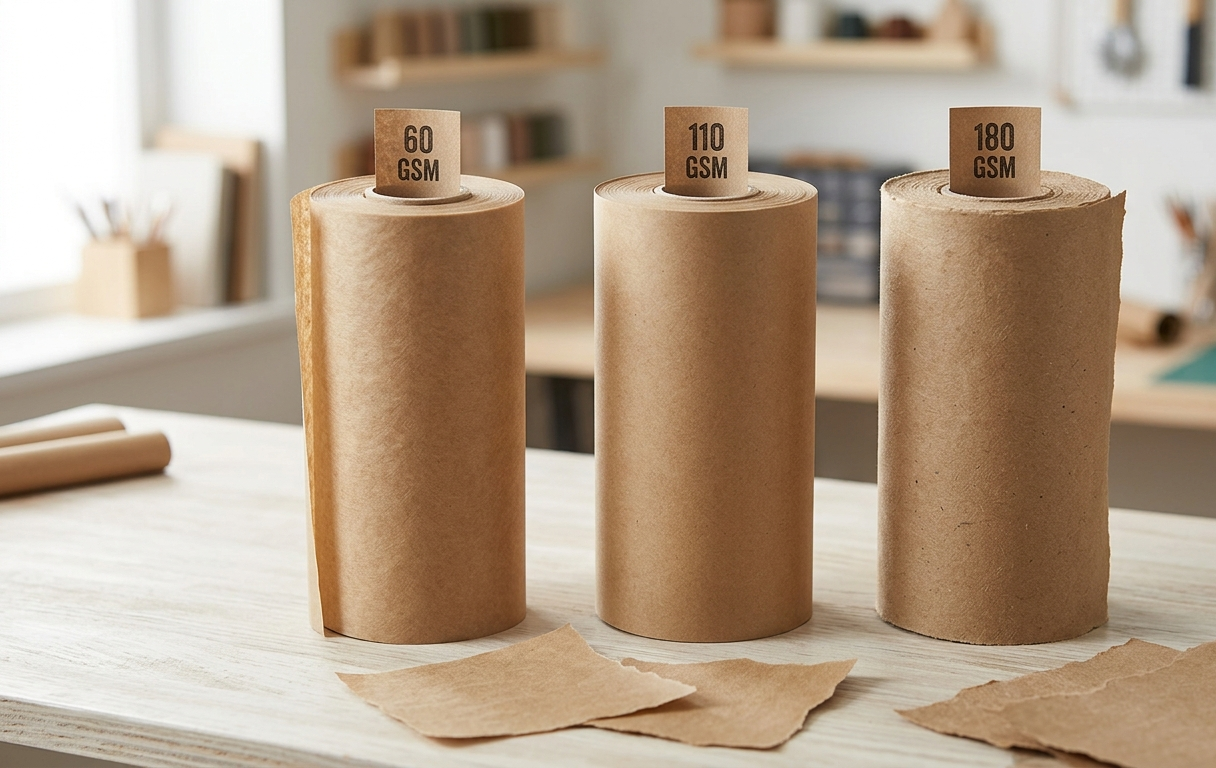
Partition paper is engineered around what it must protect. For electronics, sulfur-free paper with low chloride content is the default. For glass and photovoltaic cells, the priority is a smooth, low-dust surface with controlled pH. For consumer goods, a basic kraft or recycled paper grade is often adequate. The basis weight typically runs from 30 to 80 grams per square meter.
Interleaving Paper Materials
Interleaving paper for industrial use is dominated by sulfur-free and acid-free grades. Glass interleaving in particular requires very tightly controlled chemistry — even trace levels of sulfur or chloride can leave residue marks on stored glass over weeks. Specialty interleaving papers also include MG (machine-glazed) papers for smoothness and crepe papers for cushion. Basis weight typically runs from 35 to 100 grams per square meter.
Slip Sheet Materials
Slip sheets are heavier and structural. Solid fiberboard or laminated kraft paper sheets typically run from 600 grams up to multiple kilograms per square meter. Some slip sheets are reinforced with a polyester scrim or coated with a low-friction surface for repeated push-pull handling. The mechanical properties — tear strength, edge crush, moisture resistance — matter far more than chemical purity.
Specifying the Right Product: Questions to Ask
Before placing any volume order, work through these questions:
- What am I actually protecting against — physical contact, chemical contamination, or freight handling?
- What is the metal or surface chemistry of the product? (This determines whether sulfur-free is required.)
- What is the unit size, and what stack configuration?
- Is the protection needed for a few hours of transit or for months of storage?
- What humidity and temperature range will the package see?
- Will the paper be discarded after one use, or does it need to handle multiple cycles?
- Are there specific certifications required — ISO, RoHS, FDA, sulfur-free verification?
Common Mistakes to Avoid
Using Standard Kraft Where Sulfur-Free Is Needed
This is the most expensive mistake in electronics packaging. Standard kraft is cheap, but for any application involving silver, copper, or sensitive PCB plating, the sulfur content in standard kraft will cause measurable tarnish over time. The cost gap to certified sulfur-free interleaving is small. The cost of a contaminated batch is large.
Calling a Slip Sheet a Pallet Replacement Without Push-Pull Equipment
A slip sheet only saves money if you have the push-pull forklift attachment to handle it. Trying to replace pallets with slip sheets in a facility that only has standard fork trucks creates a handling bottleneck that wipes out the freight savings.
Specifying Too Heavy a Paper for Interleaving
Heavier interleaving paper does not mean more protection — it can mean more cost, more weight, more handling difficulty, and more disposal volume. Most flat-sheet interleaving is well-served by 50–80 gsm paper. The protection is delivered by chemistry and surface flatness, not by thickness.
Frequently Asked Questions
Is interleaving paper the same as partition paper?
They overlap heavily, but the most useful distinction is scale and shape. Interleaving paper goes between large flat sheets in a uniform stack. Partition paper goes between individual units inside a container. Many suppliers stock the same base papers and slit them to different formats for either use.
Can a slip sheet protect product surfaces?
Not really. Slip sheets are designed for load handling, not surface protection. If you place a slip sheet under a load and stack product directly on the slip sheet without additional protection, the slip sheet’s surface texture can mark the bottom layer. Use slip sheets for handling and partition or interleaving paper for surface protection.
Does partition paper need to be acid-free?
For long-term storage of metals or sensitive electronics, yes. Acid migration over months can cause discoloration on copper, silver, and iron surfaces. For short-term beverage or consumer packaging where the partition paper is in contact for days to weeks, standard pH-neutral paper is usually adequate.
Are slip sheets recyclable?
Most fiberboard and kraft slip sheets are recyclable through standard cardboard recycling. Slip sheets that have been laminated with plastic films or reinforced with scrim may not be acceptable in standard streams. Always check with your local recycler before assuming.
How thick should interleaving paper be?
For most flat-sheet applications, 50–70 gsm is the sweet spot. Below 40 gsm, the paper can tear or fail to provide adequate cushion. Above 100 gsm, you are paying for material that does not improve protection. The exception is very heavy or very rough product surfaces, where a creped or thicker paper helps cushion impact.
The Bottom Line
Partition paper protects individual units from each other inside a container. Interleaving paper protects flat sheets from abrasion in a stack. A slip sheet replaces a wood pallet for material handling. Each tool exists because each problem is different. Match the tool to the problem, specify the chemistry that matches your product surface, and verify with documentation before any volume order. Get this right and your packaging line stops creating the damage it is supposed to prevent.